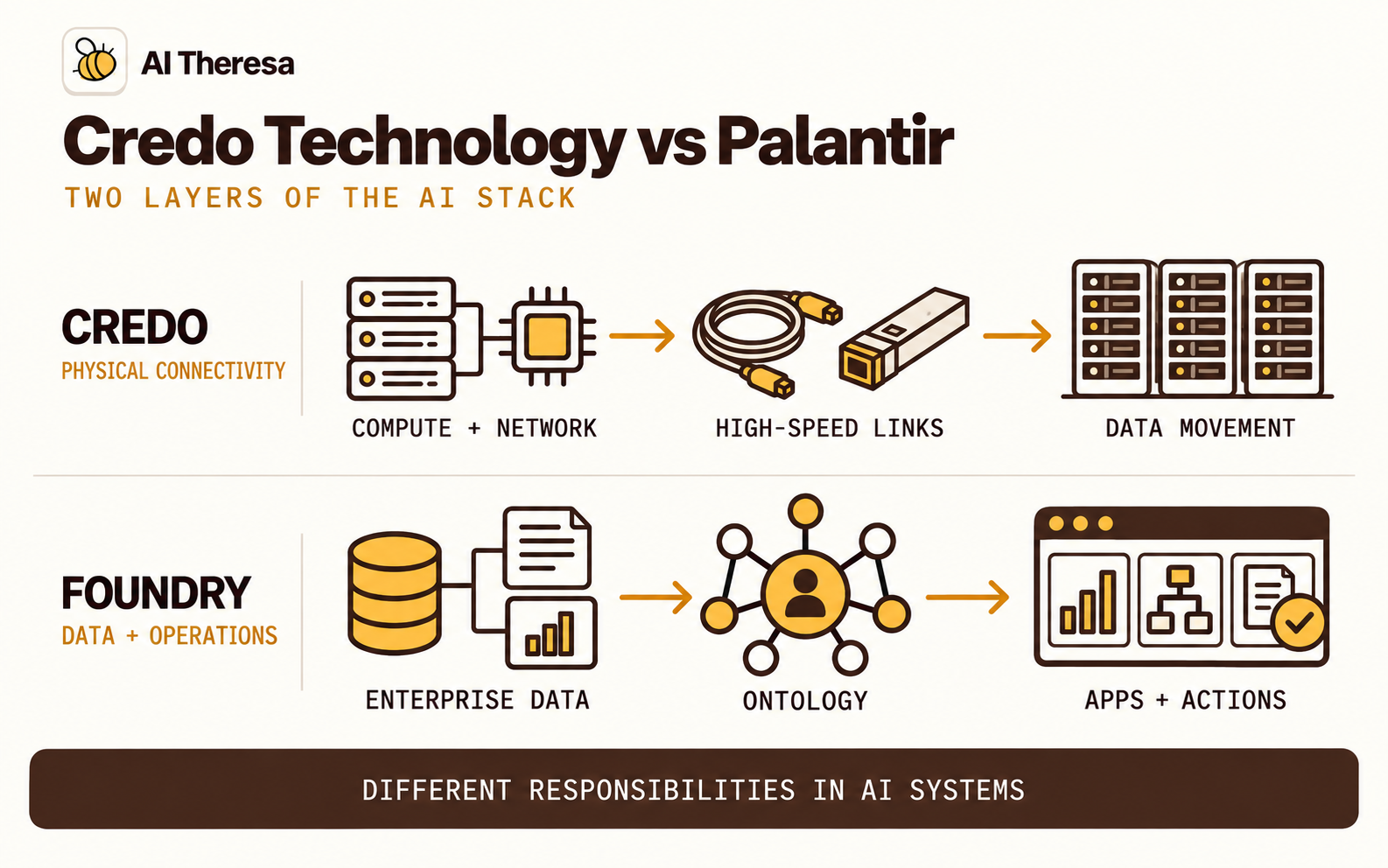
Credo Technology and Palantir participate in AI through different products. Credo supplies physical connectivity, including cable assemblies and semiconductor technology. Palantir Foundry supplies software for integrating business records and building operational applications. A team selecting server connections and a team redesigning inventory allocation are making different purchases, even if both describe the project as AI infrastructure.
Both companies describe connectivity, but at different levels. Credo helps hardware exchange data. Foundry helps applications relate records and act on them: identifying which supplier a record describes, for example, and which business rules apply.
This comparison focuses on products, architecture, implementation, and costs. Here, Palantir means Foundry with AIP where model and agent capabilities are relevant.
What Is Credo Technology?
Credo Technology is a connectivity company whose products support data centers, AI infrastructure, and other high-bandwidth computing environments. Its portfolio includes active electrical cables, optical connectivity products, retimers, and serializer/deserializer technology. These products operate close to the hardware carrying data between chips, boards, and systems. See Credo's product portfolio.
Four terms help explain what Credo sells:
- Active electrical cable (AEC): A copper cable assembly with active electronics that help maintain the signal across a connection.
- Optical DSP: A chip that processes signals in a high-speed optical connection.
- Retimer: A component that recovers and retransmits a signal to help a link meet its electrical requirements.
- SerDes: Circuits that turn several parallel data streams into a faster serial stream, and back again.
Credo's AEC catalog distinguishes products by connector configuration, speed, reach, and operating conditions. Its optical DSP portfolio addresses optical modules and active optical cables. Those are different ways to solve a physical connectivity requirement; the appropriate choice depends on the equipment and link design.
Credo also supplies SerDes IP and chiplets. These serve a different buyer from a finished cable assembly: a chip designer may incorporate licensed IP or a chiplet into a new semiconductor design, while a data-center operator needs a cable that works with equipment already selected.
Get Started with Theresa for FREEWhat Is Palantir Foundry?
Palantir Foundry is an enterprise software platform for integrating data, developing logic, and building analytical and operational applications. Its role is to make information from different systems usable within a common decision process. Palantir's architecture overview describes the relationship between the platform's services and its Ontology.
The Ontology gives applications shared definitions of things such as suppliers, equipment, and work orders. An object is one record; its properties are details such as an equipment number. Relationships connect records, and actions define permitted changes. Palantir's Ontology documentation explains how these fit together.
Consider a maintenance application that links a machine to its sensor history, open work orders, spare parts, and production schedule. A planner could see what taking it offline would affect before approving the work. Building that application requires the records to refer to the same machine and the team to agree on who can change its schedule.
Foundry supports that work through data integration and application tooling. AIP adds capabilities for connecting AI models to enterprise context, developing agents and AI logic, and evaluating behavior. Foundry and AIP have related roles, but a conventional Foundry application does not need a language model for every decision. See the official AIP capabilities overview.
Foundry sits above the underlying compute and networking infrastructure. Your organization or infrastructure provider still supplies and operates that hardware.
Get Started with Theresa for FREECredo Technology vs Palantir: At a Glance
| Dimension | Credo Technology | Palantir Foundry |
|---|---|---|
| Primary role | High-speed physical connectivity | Enterprise data and operational software |
| Main products | Cable assemblies, connectivity silicon, optical products, SerDes IP and chiplets | Data integration, logic, Ontology, analytics, applications, and workflows |
| Typical evaluation team | Network, hardware, semiconductor, and infrastructure engineers | Data engineers, application builders, security teams, and business operators |
| Meaning of connectivity | Electrical or optical links between hardware endpoints | Connections to enterprise data sources and operational systems |
| Relationship to AI | Supports the infrastructure that transports AI workload data | Supplies business context and workflows; AIP adds model and agent capabilities |
| Integration work | Equipment compatibility, electrical qualification (testing that the equipment works reliably together), firmware, and physical installation | Source mapping, transformations, object definitions, permissions, and application development |
| Useful acceptance measures | Link stability, throughput, power, reach, and interoperability | Data freshness, correctness, access control, workflow completion, and adoption |
| Procurement basis | Specific components, assemblies, or IP agreements | Platform agreement, deployment scope, and applicable usage terms |
| Replaces the other? | Does not replace Foundry's data or application services | Does not replace physical connectivity components |
Credo Technology vs Palantir: Key Differences
What each company connects
Credo's products carry data along a physical path. The first question is whether two endpoints can communicate at the required speed across a given cable or optical connection. The answer depends on the endpoints, the distance, and the conditions in which the equipment runs.
Foundry works with the meaning and use of enterprise information. Its data integration framework connects source systems and supports transformation and data management. An application needs to know whether two records refer to the same supplier, which inventory figure is current, and who can approve a change.
Hardware qualification versus workflow implementation
A hardware evaluation uses the actual endpoints and operating environment. Beyond fitting the connector, the link must support the required signaling, firmware, temperatures, and network layout. Changing infrastructure can require testing many equipment combinations.
A Foundry evaluation follows a representative decision. Allocating inventory involves finding available stock, applying allocation rules, and sending an authorized update to the destination system. Missing stock records and failed updates belong in the demonstration because staff will need to handle them in daily use.
What can go wrong
For connectivity, reliability means keeping the link stable under representative traffic and environmental conditions. Testing the complete system reveals how equipment limits and other traffic affect performance beyond a component's advertised capability.
For Foundry, reliability includes the correctness and availability of data and workflows. Authorization adds another dimension: a user may be able to view an order without being allowed to change it. Palantir documents mandatory and discretionary controls, resource permissions, and granular policies in its security overview.
These failures need separate tests: network stability, access permissions, and behavior when a connection is lost.
Different ways to measure value
For an illustrative diagnosis, suppose an inventory screen takes ten seconds to answer. Measure where those seconds go. Eight seconds spent reconciling product identifiers calls for data or application work; replacing a cable would not correct the matching rule. If measurements instead show interruptions on a physical link, investigate that connection and its supported components. Neither observation alone establishes which vendor to buy from.
A connectivity purchase should be evaluated against a specified link and workload. Useful measures include sustained transfer behavior, interruptions, power per port, and service effort. A faster nominal link provides little benefit if storage or compute remains the bottleneck.
For Foundry, the unit of value is the supported business process. A maintenance application might reduce time spent locating related work orders. An allocation application might reduce manual reconciliation between inventory and customer commitments. Measure the changed work, including review and corrections, rather than counting dashboards or model calls.
A company can therefore use both technologies without integrating the products directly. Network and application teams measure different outcomes, even when their projects support the same business process.
Get Started with Theresa for FREECredo Technology vs Palantir: Core Architecture
Credo's place in a hardware connection
A network interface sends data through a link to another endpoint, often a switch. The signal must arrive in a form the receiving electronics can recover. Cable characteristics, distance, and the endpoint design affect that process. The physical layer carries bits; it does not interpret an order, a model prompt, or a database row.
An active electrical cable includes electronics within the assembly to support signal transmission over copper. A retimer reads an arriving signal and sends it onward with refreshed timing, helping the receiver distinguish the transmitted data. This differs from a passive cable, whose conductors carry the signal without active regeneration. Credo's AEC product catalog organizes offerings by connection configuration and supported speeds and conditions.
An optical design uses a different transmission medium. An optical DSP can be part of the transceiver electronics that prepare or recover data for the optical link. It is a component within that design, not necessarily the complete transceiver. SerDes IP sits further inside the semiconductor design, converting between parallel data and high-speed serial signaling.
Credo supplies products at several points in a hardware design; a connection does not necessarily use all of them. A finished cable buyer, an optical module builder, and a chip designer each have different interfaces to integrate and equipment to test.
Foundry's place in an operational application
A Foundry application might follow this path:
- Source systems: Records arrive from databases, business applications, files, or other approved sources.
- Data preparation: Connections and transformations prepare information for use, with freshness and quality checks.
- Operational model: Objects and relationships connect information to the business entities the workflow uses.
- Application and logic: Users inspect the situation, apply rules, and evaluate possible actions.
- Execution and feedback: Authorized changes are recorded, and any external updates are reconciled with the destination system.
A read-only application may stop at analysis. An application that updates another system needs to confirm whether that update succeeded. AI can help with parts of either process, such as interpreting a request, without replacing the rules for making changes.
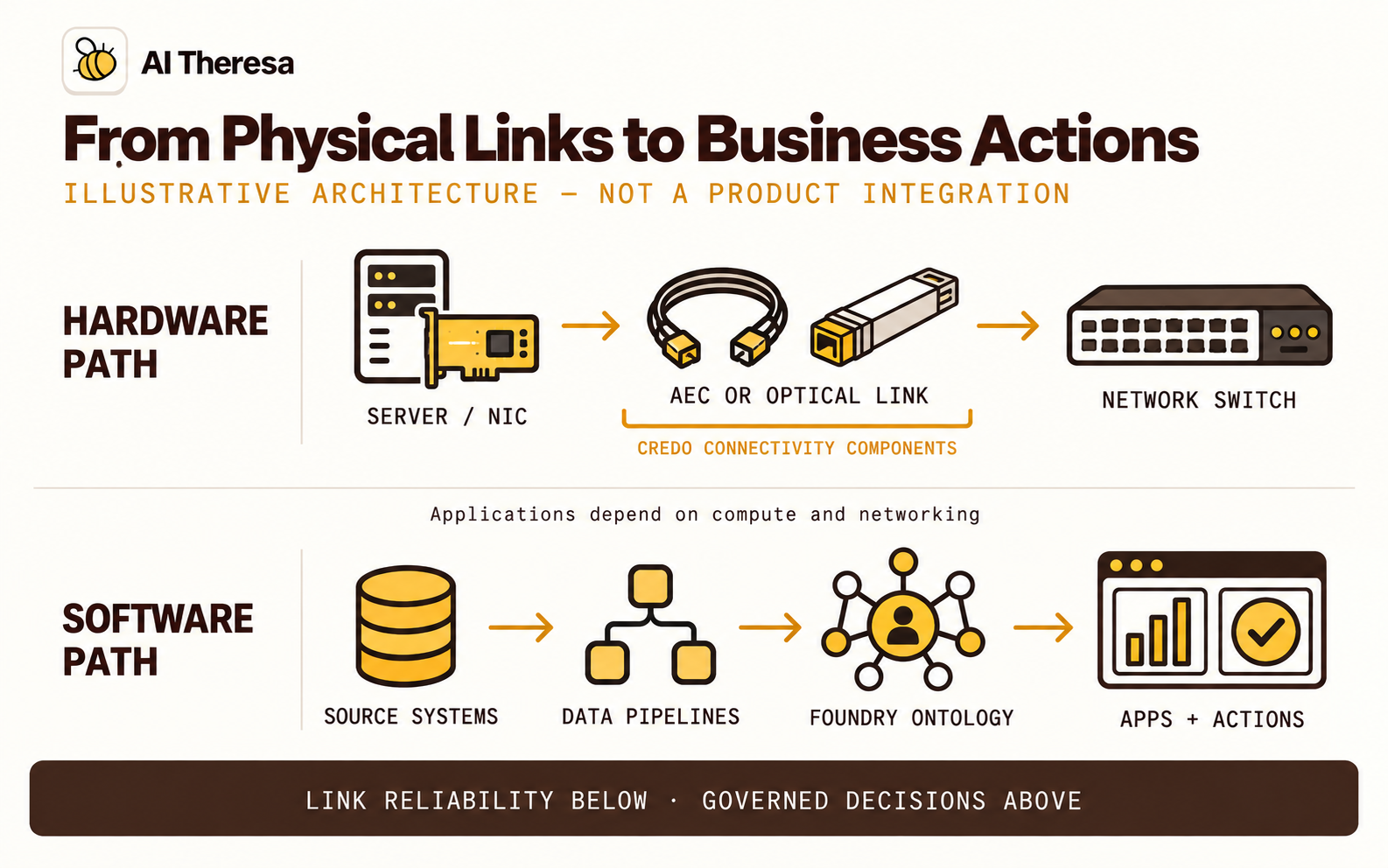
Can both appear in the same environment?
Yes, the two types of technology can be used in the same environment. Enterprise software runs on infrastructure assembled from many suppliers' products. Using Foundry would not, by itself, create a requirement to buy Credo components.
Get Started with Theresa for FREECredo Technology vs Palantir: Pricing
A cable assembly and an enterprise software agreement have little in common as purchases. The more useful question is what each will cost to install, run, and maintain for the job you need it to do.
Credo: specify the hardware or IP requirement
Credo's public product pages describe technical configurations without a universal price list. To request a quote, specify the product family, endpoints, reach, quantity, and support you need. Licensing IP for a chip design requires a separate discussion from buying finished hardware.
When budgeting for a deployment, include:
connectivity cost = acquisition + qualification + installation + power and cooling + service and replacement
These budget categories are not Credo's billing formula. Including testing, power, and replacement costs gives a more complete estimate of the product's total cost over its service life than the purchase price alone. Using the same service life makes estimates for compatible products easier to compare.
Palantir: separate platform terms from implementation
Palantir's resource usage documentation explains how the platform measures compute and storage consumption. It helps you understand what a workload consumes, but you'll need the deployment's contract terms to turn that usage into a cost estimate.
For AI workloads, Palantir also publishes AIP compute translation information. Its rates apply only to the environments and contract terms specified on the page, so an estimate needs the rates that apply to your deployment.
The platform agreement is only part of the budget:
operational platform cost = contract and usage + data integration + application delivery + ongoing ownership
Some agreements include infrastructure, support, or implementation services. Separating those inclusions avoids double counting and leaves a clearer estimate of the customer's ongoing work on pipelines, permissions, object definitions, and integrations.
| Budget question | Connectivity evaluation | Foundry evaluation |
|---|---|---|
| What is being purchased? | A qualified component, assembly, or IP right | A defined platform scope and operational workload |
| What drives scale? | Endpoint count, link configuration, and equipment requirements | Data processing, storage, application usage, and workflow scope |
| What work sits outside the quote? | Qualification, installation, and infrastructure operations | Cleaning source data, defining records and rules, rollout, and maintenance |
| How should value be tested? | Meet the link and system requirements over the expected service life | Improve a measured business process with acceptable operating cost |
When to Use Credo Technology
Consider Credo when your team is selecting or designing a physical connection. The relevant product depends on what the team is building:
| Your responsibility | Product category to investigate | Information needed before selection |
|---|---|---|
| Connect installed servers or switches | A finished cable assembly | Endpoint models, signaling, reach, routing, and supported configurations |
| Design an optical module or link | Optical connectivity components | The complete optical design, power budget, and component interfaces |
| Design semiconductor connectivity | SerDes designs licensed for use in a chip, or small chip components called chiplets | Process compatibility, integration requirements, and qualification evidence |
Credo's product portfolio separates these offerings. Buying at the wrong level leaves missing engineering work: a component specification does not describe a complete qualified module, and a finished cable cannot substitute for an IP block in a chip design.
Compatibility testing covers the complete equipment combination under representative traffic and temperatures, beyond the physical fit of its connectors.
If your team only consumes a public cloud service, it may not select these components. The cloud provider controls the physical network. Your purchasing criteria then concern service throughput, latency, availability, and cost, while component qualification belongs to the provider.
Get Started with Theresa for FREEWhen to Use Palantir?
Consider Foundry when several applications need a consistent representation of the same business entities and operations. Its Ontology can give those applications shared objects, relationships, and actions. The implementation still needs source mappings and agreed business definitions.
For maintenance planning, the implementation needs to join an equipment identifier to open work orders and the production schedule. A useful acceptance case asks whether a planner can select one machine, see the affected production, and record an approved maintenance window. It tests the complete application across its source records and permitted actions.
The shared definitions become more useful when parts planning, reliability analysis, and production scheduling all use the same equipment records.
For a single report with stable inputs, an existing warehouse and conventional application may already be sufficient. Compare the work of maintaining that solution with the work of adopting and operating a wider platform. Our Databricks comparison and Palantir alternatives guide examine those software choices.
Get Started with Theresa for FREEConclusion
A useful Credo evaluation ends with a qualified connection or component design. A useful Foundry evaluation ends with an application whose data, definitions, and actions support the intended business process. Those deliverables explain why their specifications and cost models differ.
The right starting point is the problem your team can demonstrate: a physical connection that needs improvement, or an application that needs better information and rules.