FDE as a Service provides an external engineering team that follows a business problem through investigation, implementation, deployment, and handover. It is useful when delivery crosses data systems, applications, and the people using them. The customer buys engineering responsibility for an agreed scope, rather than a particular AI product.
The arrangement fits work that needs direct access to users and cannot be specified completely before investigation begins. It is less compelling when a stable backlog can be handled by an existing team or a narrowly defined specialist contract.
Providers may sell a project, an embedded engineering team, ongoing operation, or a combination. The deliverables and support terms determine which arrangement the customer receives.
What Is FDE as a Service?
FDE stands for forward-deployed engineering, or forward-deployed engineer when referring to a person. An FDE works closely with a customer's users and technical teams to turn an operational problem into functioning software. The work can involve data, application code, integrations, infrastructure, and AI.
Palantir's forward-deployed software engineer role illustrates the approach: engineers work directly with customers, investigate their problems, and build production software. Independent service providers adapt that approach to different teams and projects, so the responsibilities vary.
The “as a Service” version supplies this capacity through an external agreement. Providers may offer a scoped project, an embedded team, or ongoing support. For example, Entrans describes an FDE service covering discovery, implementation, deployment, and continued iteration. The proposal determines which of those responsibilities the provider takes on.
An embedded engineer needs regular access to users and technical teams, though they may work remotely. For example, someone fixing a finance report needs to speak with the person who reconciles it, not just read a ticket. AI development tools may help with implementation; engineers still own the design and review.
Get Started with Theresa for FREEHow Does FDE as a Service Work?
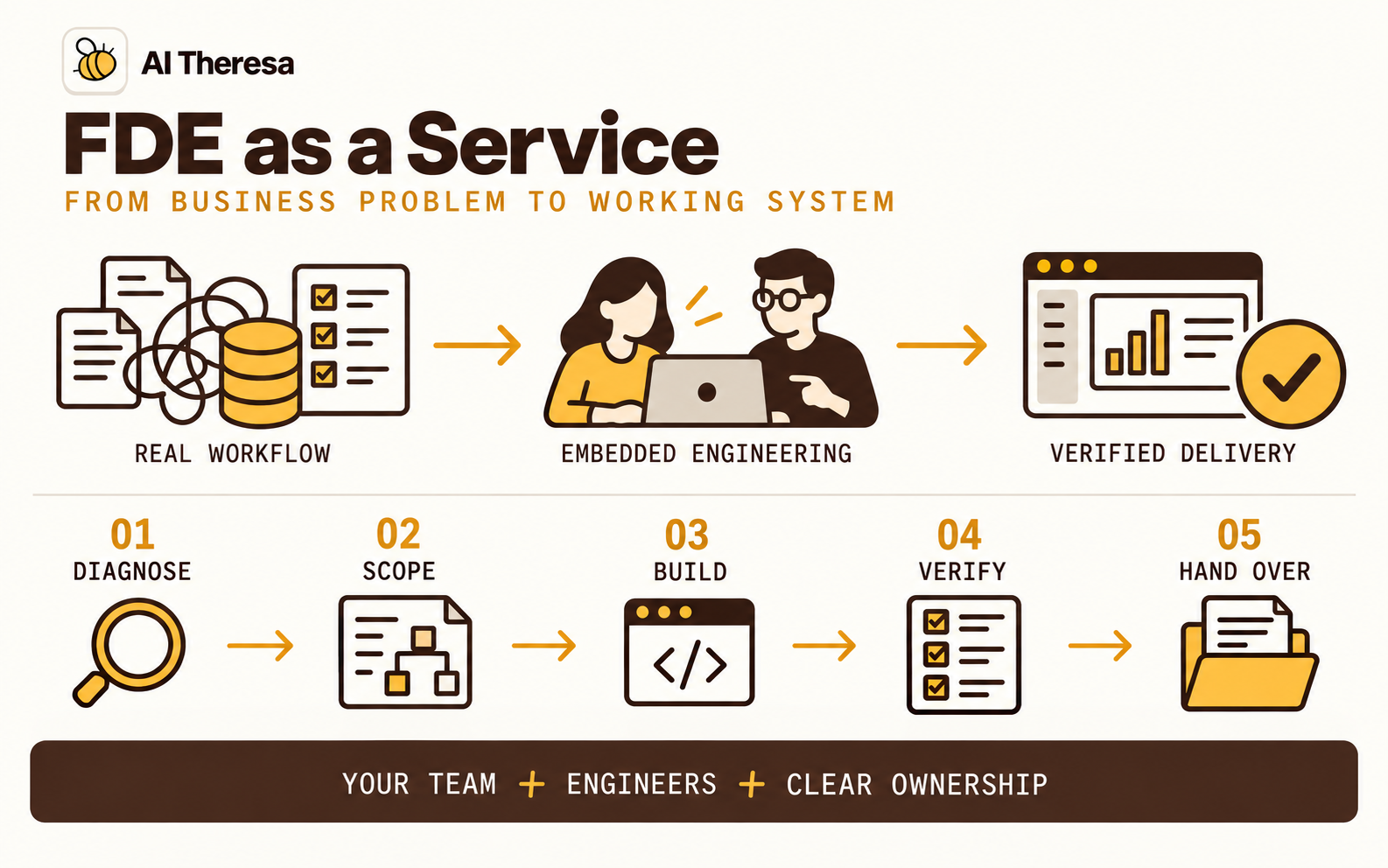
An engagement moves from investigating the problem to agreeing on a fix, building it, and putting it into use. Handover or continuing support determines who looks after the result.
1. Diagnose the actual workflow
The engineer follows how an input becomes an output people use. For reporting, this can mean tracing a source event through transformations to the figure an analyst reconciles. A missing event, a mistaken formula, and a legitimate manual adjustment can produce similar symptoms but require different fixes.
Discovery should produce evidence the team can inspect: a source-to-output map, a reproducible discrepancy, and the rule that explains the expected result. The business owner supplies the meaning of the metric; the engineer establishes where the implementation diverges. A baseline records the current failure rate or time spent correcting it.
2. Agree on scope and acceptance
Write down what completion means and who signs it off. “Improve reporting” is vague. “Produce the weekly report from approved sources, reconcile specified totals, and flag incomplete inputs” gives both teams something they can test.
Agree on access, deployment authority, exclusions, and how additional discoveries affect the schedule and budget.
3. Build inside the existing environment
The first working version should cover a complete, narrow path through the customer's systems. For a reporting fix, that might include one input period, the affected transformation, and the report used to check the result. This exposes integration problems earlier than completing every component separately.
The engineer then expands coverage to the exceptions discovered with users. A late event may require a correction to a previous period. A missing source may need an explicit incomplete status rather than a zero. Those behaviors belong in the implementation and its tests, so later maintainers can see why the rules exist.
Code review and release follow the customer's process. The receiving team also needs readable code, settings, and instructions for running it.
4. Verify and release
Before release, the team compares the result with the baseline and checks permissions, failure behavior, and usability. A report should distinguish missing inputs from genuine zero values; an integration should show whether an external update completed. Monitoring and a recovery plan help the operating team deal with failures after launch.
5. Hand over or continue support
Handover makes the operating knowledge usable by another person. The package includes source code, deployment instructions, configuration references, and a runbook describing common failures and recovery. A customer engineer can test the handover by performing a routine operation using those materials.
For example, the receiving engineer might replay an incomplete reporting period and verify that it does not duplicate existing records. That exercise reveals missing permissions, undocumented commands, or assumptions that only the delivery team knows. If the provider will operate the system, the agreement instead needs defined support coverage and a path for future changes.
Get Started with Theresa for FREEFDE as a Service vs Traditional Data Engineering
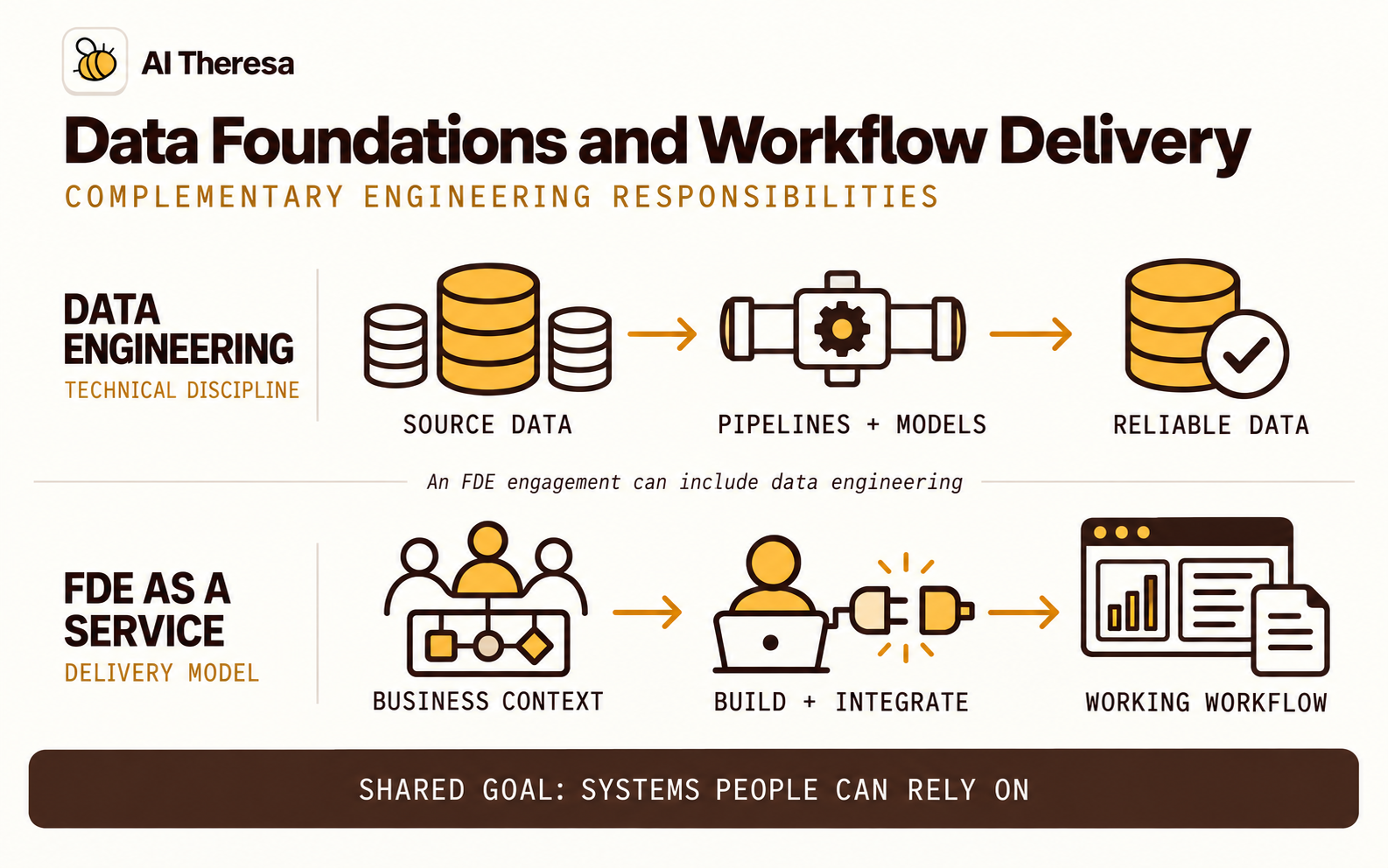
These categories describe different things. Data engineering is a technical discipline; FDE as a Service is a delivery model. A forward-deployed engagement may include substantial data engineering, and an internal data engineer may work directly with business users.
Microsoft's data engineer role outline includes ingesting and transforming data, managing analytics solutions, and monitoring and optimizing them. Those foundations remain necessary when an FDE builds a workflow on top of them.
| Dimension | Traditional data engineering focus | FDE as a Service focus |
|---|---|---|
| Starting point | Data requirements and platform needs | A customer workflow or operational problem |
| Common deliverables | Pipelines, data models, reliable datasets, and monitoring | An implemented solution that may combine data, applications, and integrations |
| Scope | Often centered on the data lifecycle | Can cross technical and organizational boundaries |
| Working relationship | Internal team or contracted data specialists | Embedded collaboration under a service agreement |
| Acceptance | Correctness, freshness, reliability, and efficient processing | Technical acceptance plus an agreed workflow outcome |
| Continuing ownership | Usually follows the data team's remit | Must be defined through handover or support terms |
There is plenty of overlap between these roles. Maintaining a shared data platform calls for sustained data-engineering capacity. Getting a stalled onboarding process working across three applications may call for an engineer who can follow the problem across all three, including the steps people perform manually.
Key Benefits of FDE as a Service
The main benefit is continuity between learning what is wrong and implementing the correction. Direct access to users shortens the path from a mistaken assumption to a change in the software. A reporting engineer can ask why a manual adjustment exists before replacing it with an incorrect automated rule.
A provider can also supply several specialties during one engagement. Data work may dominate discovery, while application development becomes more important during rollout. That flexibility depends on the engineers assigned to the project and their availability.
| Potential benefit | How it arises | What to measure |
|---|---|---|
| Fewer requirements handoffs | Engineers investigate with the people doing the work | Rework caused by misunderstood requirements |
| Progress across system boundaries | One delivery team connects the necessary changes | Time waiting for unresolved dependencies |
| Usable transfer of knowledge | Customer engineers review and operate the implementation | Whether routine changes still require the provider |
The savings depend partly on the customer's time in interviews, reviews, and acceptance. A fast release that requires extensive corrections may cost more overall than a slower implementation with fewer misunderstandings.
Get Started with Theresa for FREEFDE as a Service Use Cases
FDE as a Service can address repetitive publishing tasks, costly reporting, and scattered knowledge across AI agents. Here's how Theresa has approached these needs.
Batch creation and upload of Google Play in-app products
An app publisher was creating and uploading in-app purchase items to Google Play one at a time. The team also translated app descriptions manually, adding repetitive content work to the publishing process.
Theresa built tools for batch creation and upload, along with automated translation of app descriptions. For this client's app store optimization (ASO) work, the team no longer needed to review the translations manually. The tools reduced item-by-item publishing work and freed staff from repetitive translation tasks.
Faster, lower-cost reporting from BigQuery
A business generated large volumes of data each day, and its analysts repeatedly accessed BigQuery to retrieve the numbers they needed. That reporting process was slow and costly.
Theresa built a dashboard backed by optimized queries and scheduled data fetches. It gave analysts faster, lower-cost access to the same reporting operations and made the data easier for the client's agents to access. This FDE as a Service engagement improved both the work of retrieving the numbers and the team's access to them.
Enterprise memory for a team's AI agents
A client's agents needed access to knowledge and skills scattered across the organization. Here, skills meant reusable instructions and tools for internal systems, alongside the team's internal knowledge.
Theresa delivered a shared enterprise memory layer connecting those resources. It gave the team's agents a common way to find and reuse instructions, knowledge, and tools across their work.
AI Theresa combines its software with engineering delivery for problems such as unreliable pipelines, incorrect metrics, and infrastructure costs. Its Enterprise plan includes Waggle for root-cause audits, production automations shipped by Theresa, and a dedicated product lead and two engineers, with weekly syncs and monthly KPI reviews.
Theresa's pricing typically starts at $10,000 per month and increases with project size and complexity. For a single project, start by contacting Theresa to discuss the scope and contract terms. Customers still supply access, settle business definitions, and agree on acceptance, deployment, support, and handover.
Get Started with Theresa for FREEFDE as a Service: Challenges and Limitations
A small project can keep growing
Discovery often uncovers adjacent problems. Without priorities, a small workflow project can become a platform migration. Record new findings separately and decide which changes are necessary for the agreed outcome.
Progress depends on the customer's time
Engineers need appropriate access and timely answers from process owners. An external team cannot settle conflicting business definitions by itself. Assign a customer lead who can resolve requirements and coordinate decisions.
A working demo can be hard to maintain
A demonstration may rely on field names, access keys, or another service behaving exactly as expected. Review how changes are tested, how failures become visible, and how the customer can operate the system after the provider leaves.
The business still has decisions to make
The customer owns the priorities, access decisions, and acceptance criteria. Engineers can explain the technical options, but they need business owners to settle these choices. AI-assisted implementation also requires review of generated code and validation of its outputs.
The bill extends beyond engineering hours
Include discovery, delivery, infrastructure, software licenses, support, and internal staff time. Compare those costs with the value of the problem solved. An ongoing, well-understood workload may justify an internal team rather than repeated external engagements.
Get Started with Theresa for FREEHow to Choose an FDE as a Service Provider
Compare proposals against the same problem and expected deliverables. One vendor may quote discovery and a prototype, while another includes production rollout and handover. Those prices describe different purchases.
| Decision | What the proposal should establish |
|---|---|
| Staffing | The assigned engineers, relevant experience, availability, and backup coverage |
| Scope | The process to improve, boundaries, dependencies, and how discoveries change the plan |
| Acceptance | Observable results, representative inputs, user review, and who signs off |
| Delivery assets | Source code, configuration references, deployment instructions, and runbooks |
| Continued operation | The receiving team or the provider's contracted support coverage |
| Cost | Discovery, implementation, recurring support, infrastructure, and expected customer effort |
Price a discovery phase separately when the cause is still uncertain. Its output should be useful even if you stop: a reproduced problem, the records involved, and a proposed repair.
Here is a hypothetical budget for repairing one billing import. It illustrates hourly project costing, not Theresa's pricing or a typical market rate:
| Work | Assumed effort | At an assumed $150 per hour |
|---|---|---|
| Trace the discrepancy and agree on the repair | 20 hours | $3,000 |
| Build and check the import changes | 80 hours | $12,000 |
| Release, recovery exercise, and handover | 20 hours | $3,000 |
| Total engineering | 120 hours | $18,000 |
Adding an assumed $600 of temporary infrastructure gives $18,600 before tax, licenses, and the customer's staff time. A separate 20-hour support allowance would add $3,000. Moving a second billing system or adding new reports falls outside this example's scope.
Compare an internal hire over the period you actually need the work. An eight-week delivery quote and a full year's salary are different quantities. For continuing work, include recruiting, benefits, management, and what the employee will deliver after the first project. For external delivery, include repeat engagements and retained support.
A representative acceptance report or redacted runbook makes a provider's delivery practices easier to assess. This illustrative template for a billing-data repair lists the evidence a report should contain; it does not describe actual project results.
| Report field | Example of what to record |
|---|---|
| Agreed outcome | Each billing-period total reconciles to approved source records |
| Delivered change | Repository revision, mapping changes, and deployment configuration |
| Acceptance evidence | Input snapshot, expected totals, actual totals, and unresolved differences |
| Recovery exercise | Failed import reproduced; corrected retry checked for duplicate rows |
| Handover | Receiving engineer runs the import and finds a failed record using the runbook |
| Remaining work | Open exceptions, responsible person, and support end date |
The accompanying runbook should identify the failing job, the source snapshot used, and the conditions under which a retry is safe. Another engineer should be able to follow it without relying on the original implementer's recollection.
Ownership and exit terms should cover where code lives, which dependencies require continuing licenses, and how the customer obtains deployment access. These arrangements allow the receiving team to use the code and runbook after the engagement ends.
Get Started with Theresa for FREEConclusion
FDE as a Service fits work where the engineer needs to investigate with users and follow the fix across several systems. Discovery can establish the cause; a delivery engagement can implement the repair; continuing support can keep it running.
Choose the scope that matches what remains unresolved and the team available to operate the result. A useful agreement leaves both sides able to recognize completion and the customer able to continue using the work.