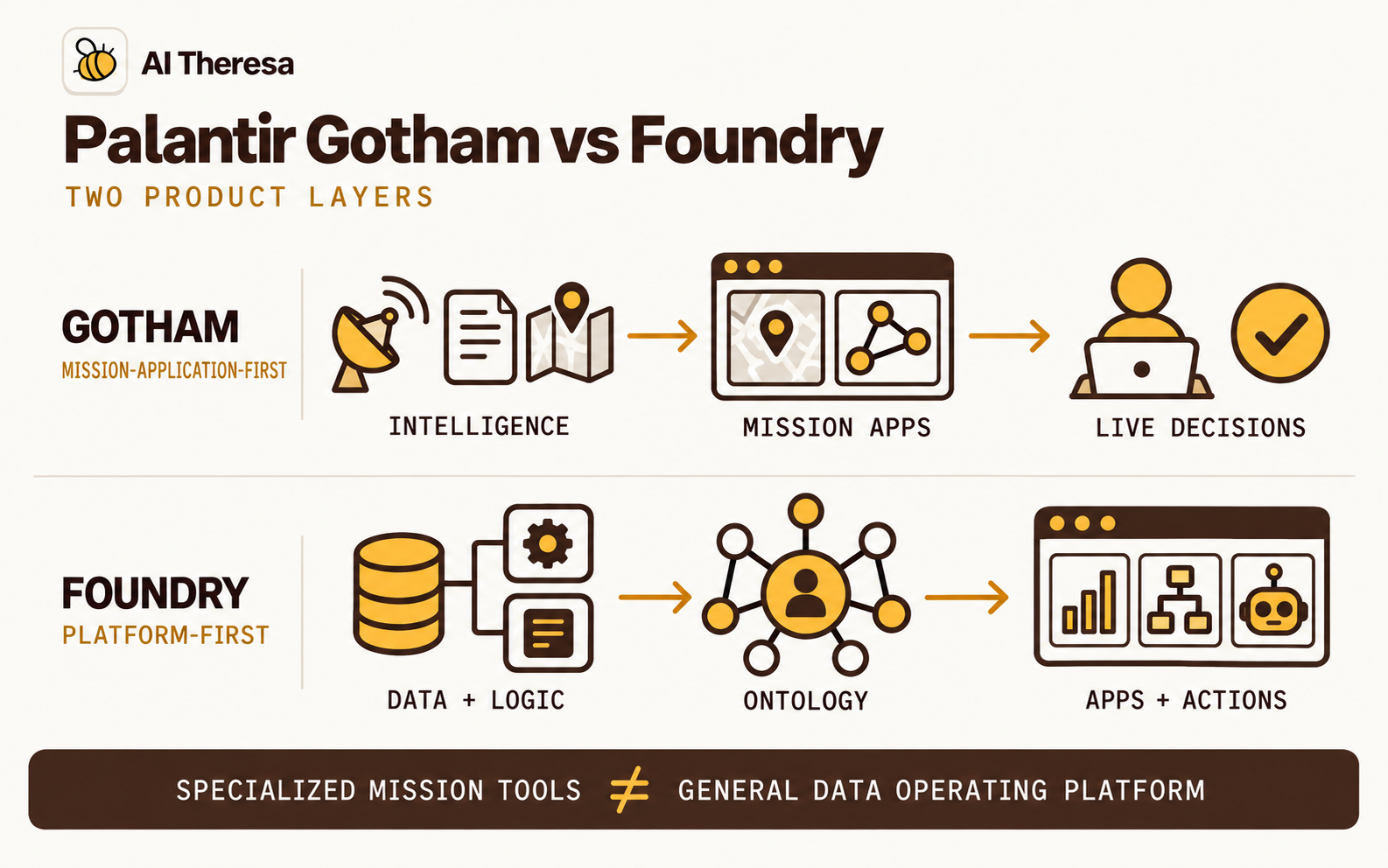
Palantir Gotham and Foundry can be parts of the same system. Gotham provides specialized applications for investigation and mission planning. Foundry connects data, defines how records relate to each other, and provides tools for analysis and application development. That foundation can support Gotham as well as other applications.
An organization might use Gotham to plan missions and a Foundry application to manage equipment repairs. Both teams can work with the same vehicle records, using different screens for different tasks. Palantir's architecture overview describes the foundation behind this arrangement: Foundry, AIP, and Apollo support specialized offerings, including those for defense and intelligence.
What Is Palantir Gotham?
Palantir Gotham is a collection of applications built for defense, intelligence, law enforcement, and other demanding operational work. It brings together reports, maps, images, video, and information arriving from sensors. Teams use that information to investigate events, understand changing conditions, and coordinate their response.
The Danish police use POL-INTEL, a customized Gotham deployment documented by researchers at IT University of Copenhagen. Denmark's Ministry of Justice described its purpose: let officers search across existing police systems, including vehicle and criminal records, instead of checking each separately.
Palantir's Gotham service definition describes applications and capabilities including:
- Maps and location tracking: In Gaia, analysts place records on a map and search by area and time to examine where an event happened. This is called geospatial analysis.
- Relationship investigation: In Graph, analysts follow connections among people, organizations, events, and documents. They can select a person and search for connected records. A graph here means a network of connections.
- Working with different kinds of evidence: Examine text, images, video, and sensor readings together. Palantir uses the term multimodal for these different formats.
- Mission planning: Compare possible plans, assign work, and follow what happens during execution.
- Work with limited connectivity: Support tasks in locations where the connection to central systems may be intermittent or unavailable.
Developers can connect other software through the Gotham API, a set of interfaces for requesting data or operations from Gotham. The available interfaces and applications depend on the customer's setup and permissions.
Get Started with Theresa for FREEWhat Is Palantir Foundry?
Palantir Foundry helps organizations connect information from different systems, prepare it for use, and build applications around it. A manufacturer might combine equipment records, maintenance history, and production schedules so a planner can decide when to stop a machine for repairs.
In Foundry, a machine, a factory, and a work order can each have a record. The work order connects to the machine it concerns; the machine connects to its factory. Those records, their relationships, and the rules for working with them form what Palantir calls an Ontology.
The machine's record is an object. Its serial number, location, and repair status are properties. An action lets an authorized person make a configured change, such as updating the repair status. Applications can reuse these definitions and rules, so the maintenance screen and production schedule refer to the same machine. Palantir's Ontology overview explains how this works.
Foundry's capabilities fall into three broad groups:
- Data services: Bring in records, clean or reshape them, store them, and monitor updates.
- Logic services: Apply calculations, business rules, and models to those records.
- Workflow services: Build screens and automated processes that people use to do their work.
Foundry includes ready-to-use analytical tools for examining tables, maps, relationships, and changes over time. Teams can also build applications with products such as Workshop and Slate, or write custom code using the Ontology SDK, a development toolkit. Its application reference covers both. Using Foundry does not mean building every screen from scratch.
Two other Palantir products have separate roles. AIP, its Artificial Intelligence Platform, adds generative-AI capabilities. Apollo delivers software and manages updates across the places it runs.
Foundry serves both companies and government organizations, including teams managing equipment availability and other operational work.
Get Started with Theresa for FREEPalantir Gotham vs Foundry: At a Glance
| Buyer's question | Palantir Gotham | Palantir Foundry |
|---|---|---|
| What am I starting with? | Specialized investigation and mission-planning applications | Data, analytical, and application-building tools |
| What will my team configure or build? | Connect mission data and adapt the supplied applications | Connect data, define business rules, and configure or build applications |
| When does it add the most value? | The team needs specialized investigation and planning tools that match its mission work | The team needs connected data, analysis, or applications shaped around its own processes |
| Can we use both? | Mission applications can use records managed in Foundry | Can provide the data and application foundation behind Gotham |
What they share: Maps, relationship analysis, AI-assisted work, and access controls appear across Palantir's offerings. Deployment options also overlap, including cloud, local, and disconnected environments. The difference lies in how these capabilities are assembled into applications, such as Gotham's mission tools or a maintenance application configured in Foundry.
Palantir's integration guide documents the connection between Foundry-managed records and Gotham applications.
Get Started with Theresa for FREEPalantir Gotham vs Foundry: Key Differences
What users receive
In Gotham, an operator can move from a reported event to related evidence, examine the location, and coordinate a response through its investigation and planning applications.
A maintenance team using Foundry might configure a screen for reviewing repair history and approving work. The people building it decide which records to show and how approval works. They can use Foundry's analytical tools alongside that application.
Gotham's supplied applications still need the customer's data and configuration. A custom Foundry workflow may also require new screens and business rules. A deployment using both can involve both kinds of work.
What builders maintain
The people building in Foundry keep data connections working and maintain the rules applications rely on. If several applications use the same vehicle-readiness field, changing what “ready” means can affect all of them, including a connected Gotham application.
Gotham application owners configure how those records appear in mission tools and check that users can follow the intended process. The same delivery team may handle both sets of work.
Analysis and action
A mission planner may ask where vehicles are and which can support a planned operation. A maintenance analyst may ask why availability fell and which repairs are holding vehicles back. Both need current records, but their screens and decisions differ.
Either task can involve maps, relationships, and analysis. Taking action requires configured operations as well. A repair request, for example, needs a connection to the maintenance system and a way to confirm that it was received. Sharing information does not automatically make every action available in every application.
Deployment requirements
A deployment's requirements follow the information it holds and the place it runs. Classified records, field use, and unreliable networks affect installation and operation whether users work in Gotham applications, Foundry applications, or both. Foundry also serves government and regulated organizations.
Apollo delivers and updates software across these environments. What remains usable during a network failure depends on where each part runs. A local application may stay open while losing access to an AI model hosted elsewhere or to new sensor readings. In that case, users could still read locally available records, but features requiring those remote services would be unavailable.
Get Started with Theresa for FREEGotham vs Foundry: Core Architecture
Between a source system and a user's screen, the software has to bring in records, connect them, and make them available to applications. This simplified view shows the work involved:
| Part of the system | What it does | What the team must decide |
|---|---|---|
| Source records and data preparation | Bring in information, clean it, and keep it updated | Which source to trust for each detail and how current it must be |
| Shared records and business rules | Connect related information and define calculations and allowed changes | What each record represents and what an update means |
| Applications | Give people screens for investigation, planning, analysis, or other work | Which information and operations each user needs |
| Delivery and operation | Install updates, manage access, monitor failures, and support users | Where the software runs and who keeps it working |
A vehicle's shared record, or operational object, might combine its serial number from an equipment register with its position from another system. A reliable identifier connects those records. Similar names alone are not enough.
Foundry provides data and application services, AIP adds generative AI, and Apollo handles software delivery. Palantir's architecture overview describes how they fit together.
Access rules apply to both information and operations. Someone may be allowed to see a vehicle's location but not a sensitive report attached to it, or to read its maintenance status without changing it. Palantir's security overview describes controls that teams configure for these distinctions.
Get Started with Theresa for FREECan Gotham and Foundry Work Together?
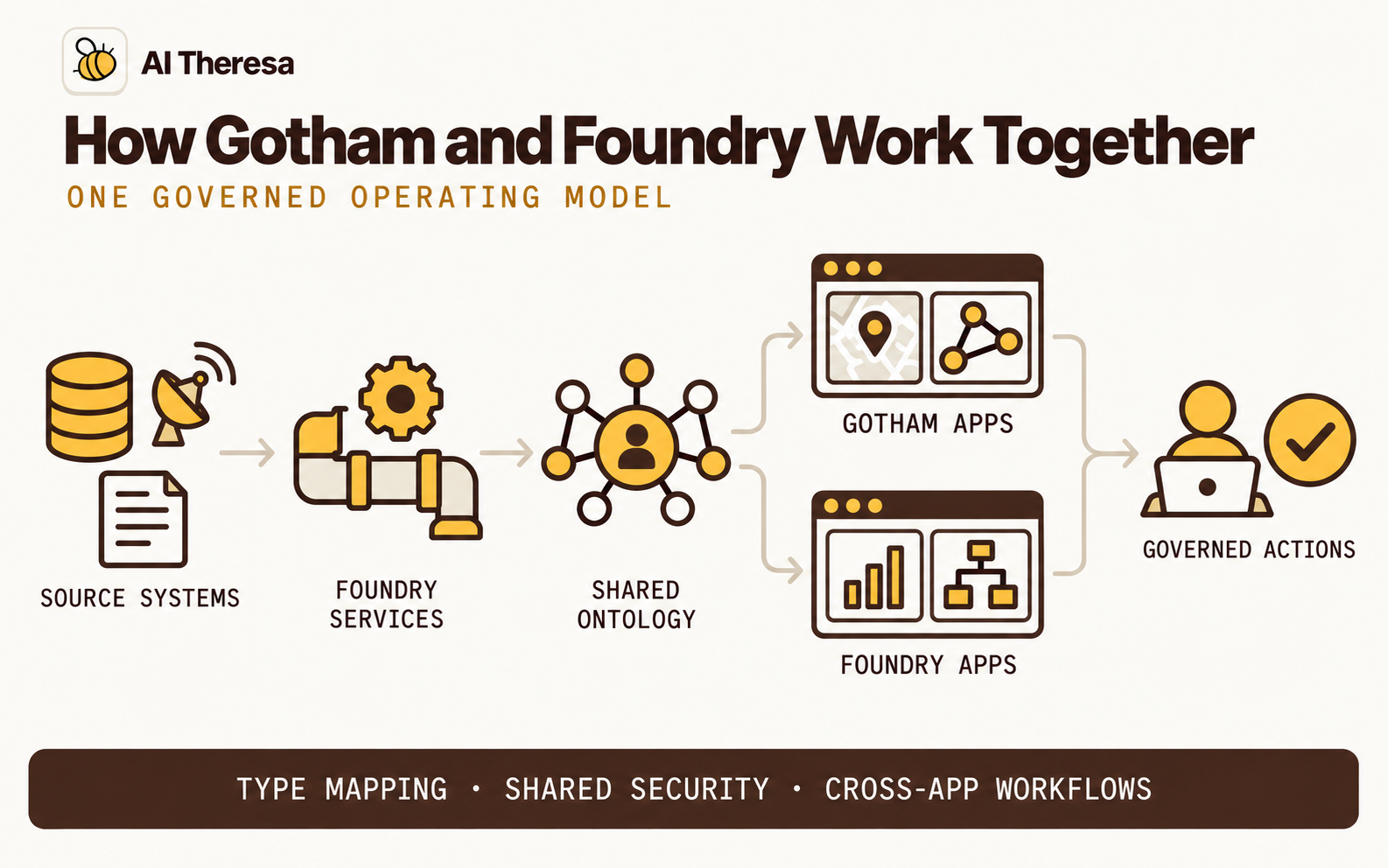
Yes. A maintenance planner might open a vehicle's repair history in a Foundry application while a mission planner sees that vehicle on a Gotham map. Both views can use the same Foundry-managed record, so the teams can work from the same information without using the same application.
The connection needs setup. One method, type mapping, tells Gotham how to use a category of Foundry records, called an object type. A builder places vehicles in Gotham's Entity category, which covers things such as people and vehicles, and selects fields such as registration and location. The mapping applies to the category, so nobody has to match every vehicle by hand.
Palantir's integration guide also describes Map Rendering Service (MRS), which lets customers with that service add Foundry objects to Gotham without type mapping.
With type mapping, Palantir documents that the data retains its access restrictions and security classifications when made available in Gotham.
Following an object across applications
Palantir also documents cross-application interactivity: ways to carry the user's current selection between applications, including paired applications and drag-and-drop. That can help a person continue investigating the same item in another view. It does not make every operation available in every screen.
Consider a hypothetical vehicle, V-104. Its shared record could support the following views and operations:
| What the user sees | Where the information comes from | What to check |
|---|---|---|
| V-104 on the mission map | The configured vehicle record and location field | The marker refers to the same V-104 as the equipment register |
| Last position: 09:42 | The location source's observation time | A recent map refresh has not made an old observation look new |
| Repair status: awaiting inspection | A maintenance record linked to V-104 | The report concerns this vehicle and shows when the status changed |
| Request an inspection | An operation configured for the application | The maintenance system returns a request reference |
The vehicle identifier connects these views, while separate timestamps show how current each detail is. Location and repair status can come from different systems and update at different times.
Get Started with Theresa for FREEGotham vs Foundry: Pricing
A Gotham vs Foundry price comparison involves more than software charges. A mission deployment may include specialized applications and field support, while a custom Foundry project may include application development and data integration. Those differences in delivery work can affect the total even when the projects use some of the same underlying services.
Palantir does not publish a universal price list for these deployments. The agreement determines which applications, platform services, installation work, usage, and support are included. A service used by both Gotham and Foundry applications may be bundled or charged separately, depending on those terms.
Foundry exposes usage through Resource Management. The current usage documentation describes:
- Processing: Computing work used to prepare data, answer queries, run models, or execute applications. Palantir meters this in compute-seconds.
- Storage: Space used to hold platform data, measured in gigabyte-months, which account for both how much is stored and for how long.
- Ontology volume: Storage used to organize Ontology data for searching and retrieval, also measured in gigabyte-months.
Keeping records uses storage; repeatedly preparing, searching, or analyzing them adds processing usage. A small user group running intensive analysis may therefore consume more resources than a larger group doing occasional lookups.
These measurements explain usage; they are not a complete public contract quote. Existing enterprise terms may use different rates or commitments.
Projects involving field operations may also need equipment, security approvals, sensor connections, and specialist training. In a combined deployment, some work can support both Gotham and Foundry applications. Preparing a vehicle register for both uses, for example, is shared integration work; configuring each application's screens is additional work.
The main cost categories are:
total cost = software + platform usage + infrastructure + integration + deployment + operations + support
These categories describe project costs rather than Palantir's billing formula. Integration includes cleaning records and connecting sources. Training users and maintaining custom applications add costs throughout operation, including work paid for through the customer's own staffing budget. The software price alone therefore understates the cost of running the solution over its service life.
Get Started with Theresa for FREEGotham vs Foundry: Pros and Cons
| Product | What it contributes | Work or limits to account for |
|---|---|---|
| Gotham | Specialized applications let teams start with existing investigation and planning tools, including views of connected evidence | Their fit matters: an ordinary reporting task may not need these tools. Mission data, application configuration, and user training still require work |
| Foundry | Data connections, shared definitions, analytical tools, and application builders can support several teams and uses, including Gotham integrations | Teams must maintain the data foundation. Custom applications need design and maintenance, and general tools do not automatically reproduce Gotham's specialized workflows |
Supplied applications can reduce the amount of interface and workflow development. Custom applications give teams control over their own processes, but also leave them responsible for maintaining those screens and rules. A project can combine both approaches without recreating every function in custom software.
Get Started with Theresa for FREEPalantir Gotham vs Foundry FAQs
Is Gotham built on Foundry?
Gotham can use Foundry-managed records within Palantir's shared Foundry, AIP, and Apollo architecture. “Built on Foundry” describes part of that relationship, but leaves out the other services and Gotham's own specialized applications.
Is Gotham only for the military?
No. Its investigation and coordination tools can also serve law enforcement, public safety, and other government work.
Can a commercial company buy Gotham instead of Foundry?
Gotham's availability for a particular commercial use requires confirmation from Palantir. Foundry's tools may be sufficient for business reporting or a custom application. Gotham adds specialized investigation and mission-planning functions when those match the work involved. A proposal can include both.
Do Gotham and Foundry use the same Ontology?
They can share Foundry-managed records and definitions through the integration methods described above. The services available in the customer's setup determine whether type mapping is needed.
Which product includes AIP?
AIP is a separate platform in Palantir's shared architecture. It works with Foundry, and AI can support Gotham mission applications. Access to particular models, agent features, and testing tools depends on the customer's agreement and deployment.
Which product has stronger security?
Both provide controls for sensitive information. Protection depends on the deployment's access rules and operating environment: who can sign in, which records they can see, and what they can change. Security approvals also apply to particular environments and uses. Neither product name alone establishes that an installation is better protected.
Can Foundry replace Gotham?
Foundry may cover some of the same analytical tasks. Replacing a Gotham application also means providing the specialized screens, workflows, integrations, and field capabilities its users rely on. Foundry's application-building tools can support development, but they do not automatically reproduce those functions. The work required depends on the application being replaced.
Get Started with Theresa for FREEConclusion
Gotham gives investigators and mission planners applications designed for their work. Foundry connects the information those applications can use and gives teams tools for analysis and building other applications. An organization can use both, with shared data supporting different teams.
Research basis: This comparison draws on Palantir's technical documentation, its UK procurement materials, and published research on POL-INTEL. The vehicle walkthrough is hypothetical; the customer example describes Palantir's deployment.
For adjacent choices, see Databricks vs Palantir and our Palantir alternatives comparison.