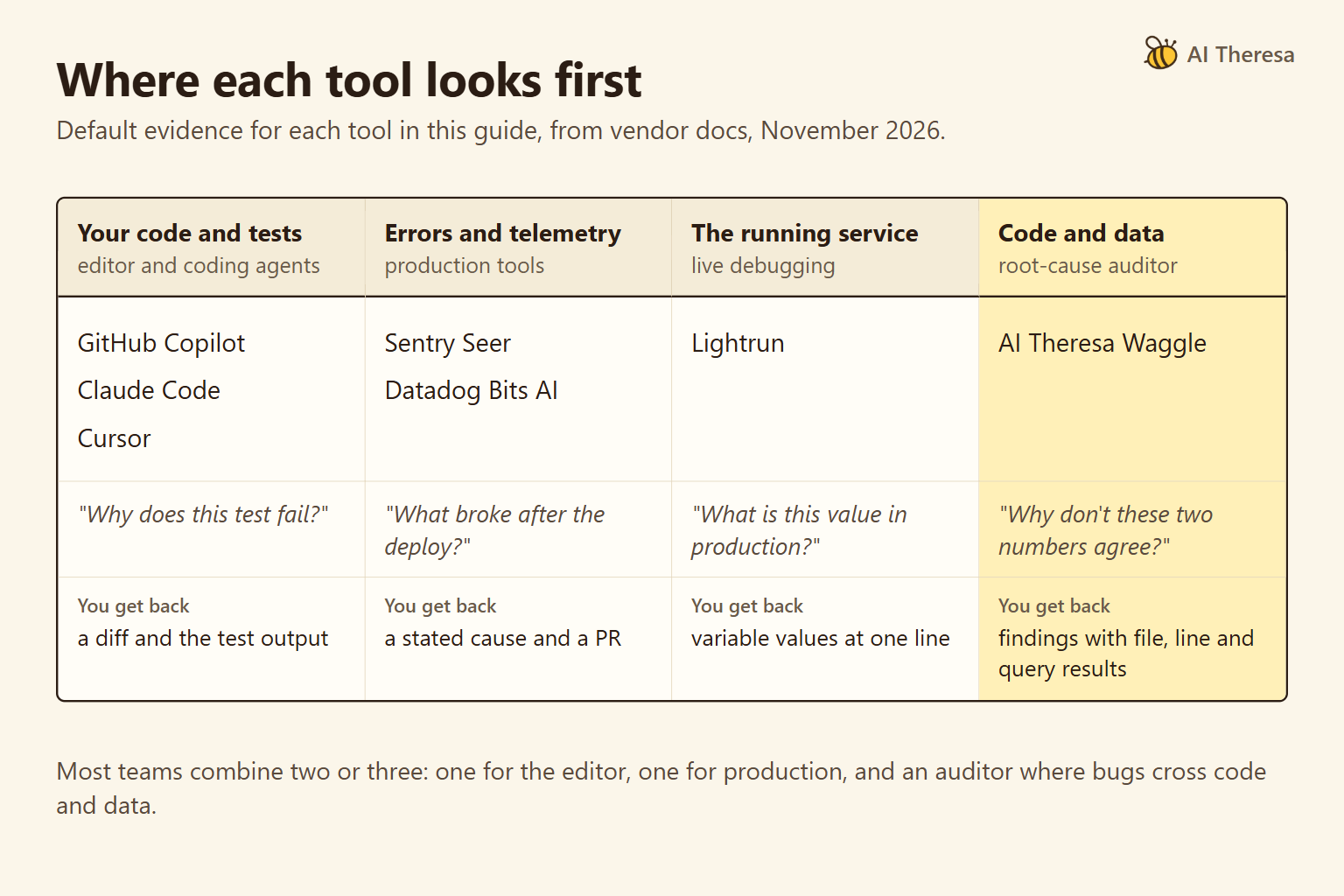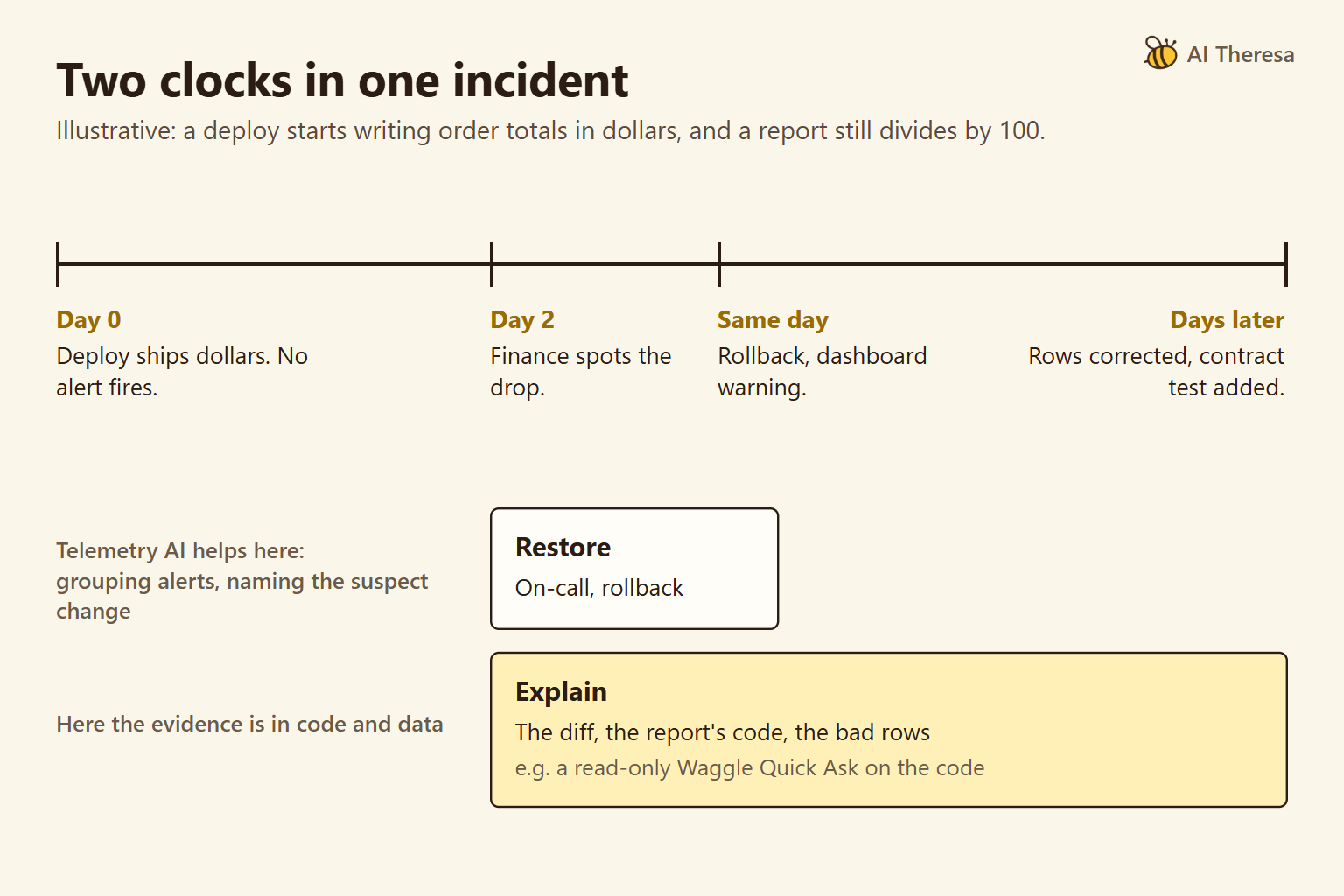
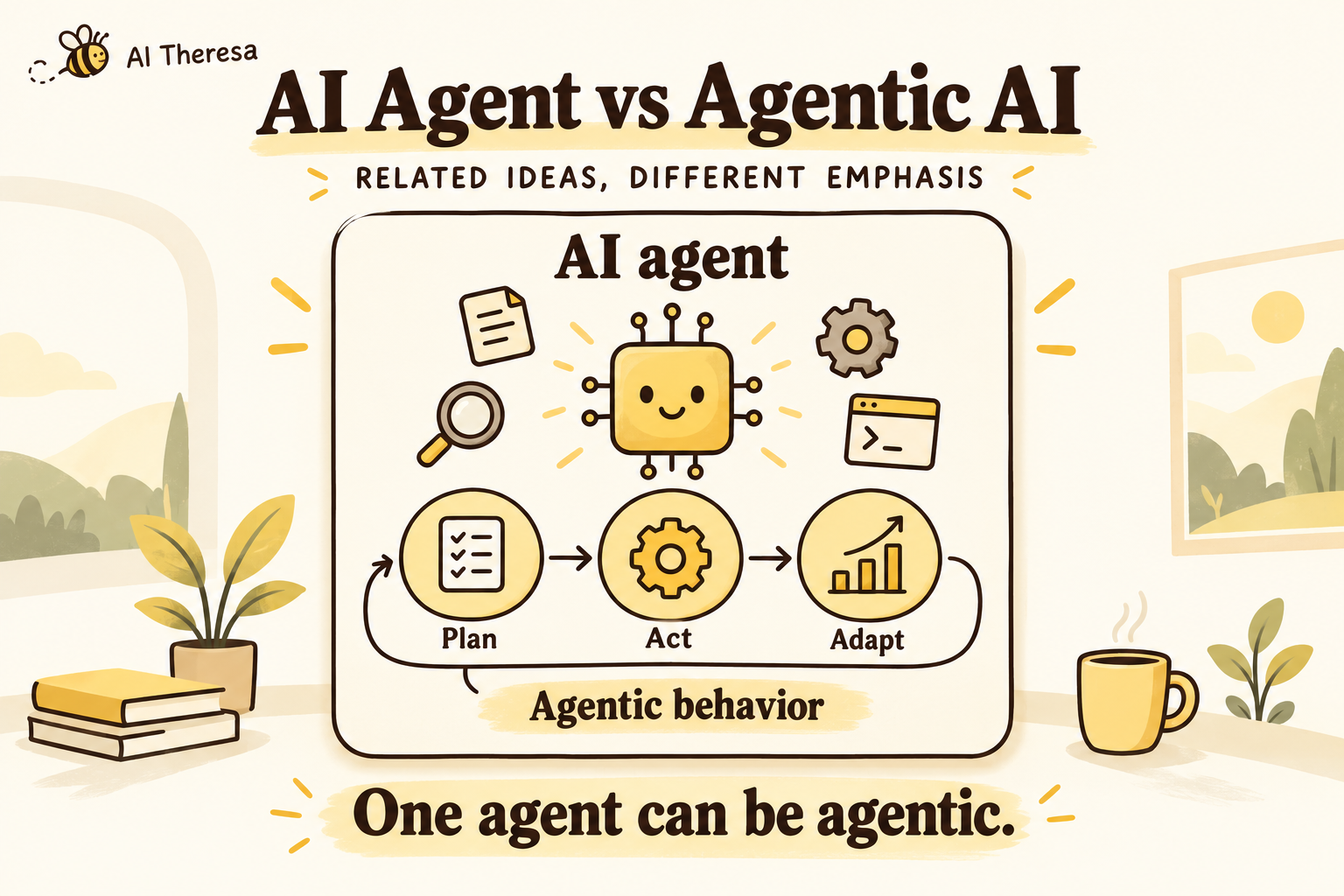
An AI agent is software that can choose and carry out steps to complete a task. Agentic AI describes its ability to decide how to proceed and adjust when something changes. The same application can be both: the agent is the system doing the work, and “agentic” describes how it works.
That overlap matters when comparing products. A business does not necessarily need to choose between an AI agent and agentic AI. It needs to decide which work to hand over, which decisions the software can make, and when a person should be involved.
What Are AI Agents?
AI agents use information and connected tools to work toward a goal. Tools let an agent perform operations, such as checking stock, running a calculation, or creating a task in another application.
Many modern agents use a large language model (LLM), AI software that interprets and generates language, to understand requests and help choose actions. The surrounding application runs those actions and controls which records the agent can access or change.
An agent can complete work, including updating a record or submitting an authorized order. Other assignments end with a recommendation for someone to approve. That boundary depends on the job and the permissions the business gives it.
Consider a hypothetical purchasing assistant asked to find a replacement laptop within an approved budget, needed by Monday. It checks the equipment catalog and suppliers, then prepares a purchase proposal. The stock lookup is one tool within the agent; every connected application does not need its own agent.
Get Started with Theresa for FREEWhat Makes AI Agentic?
Agentic behavior means choosing the next step based on what has happened so far. If a suitable laptop cannot arrive by Monday, the purchasing assistant might check another supplier or ask whether a temporary device would be acceptable.
A fixed workflow could handle those cases too, if someone had written rules for them. In an agentic approach, the AI chooses among the actions it is allowed to take. Anthropic's guide to building effective agents explains this difference between predefined workflows and processes directed by a model.
Some guides use “AI agent” for an individual worker and “agentic AI” for the larger system coordinating those workers. That describes one way to organize the software, reflected in research on multi-agent systems. A single agent can also plan, take actions, and adjust its approach, so multiple agents are not a universal requirement. This article follows the behavioral meaning described by Red Hat.
Choosing its own steps also does not mean the software can ignore business rules. It may search suppliers independently while still needing a buyer's approval to spend money.
Get Started with Theresa for FREEHow AI Agents Execute Tasks
To carry out the laptop request, the agent needs the employee's requirements, purchasing rules, and connections to the relevant business systems.
The model requests a stock lookup. The application checks that the request is allowed, sends it to the supplier system, and passes the result back to the model. The agent can then choose its next action using that information.
A simple record of the work might read:
Request: check stock for the approved laptop.
Result: the supplier responded, but the laptop is out of stock.
Next step: search the approved catalog for suitable alternatives.
Status: searching; no order submitted.
If the supplier system does not respond, availability remains unknown. That differs from a successful check showing no stock. Treating both results alike could lead the agent to reject an available product.
The application also saves the results and product details. This lets the buyer return to a proposal later without starting the conversation again. Once an approved order is submitted, the supplier's confirmation establishes whether the purchase succeeded. Generating an order request alone does not complete the transaction.
Get Started with Theresa for FREEHow Agentic AI Plans and Makes Decisions
Planning means working out what to check or do next. The purchasing assistant has a budget, required specifications, and a deadline. A cheap laptop is not suitable if it cannot run the employee's software or arrive on time.
Suppose the first supplier has the right laptop but cannot deliver until Wednesday. The assistant can check another approved supplier. If none can meet Monday's deadline, it can ask about a temporary device instead of repeatedly searching the same stock.
Keeping track of rejected options helps it avoid repeating work. The model receives the updated findings as the task continues; it does not need to retrain itself after every search.
| New information | Fixed purchasing workflow | Agent choosing its next step |
|---|---|---|
| The chosen laptop arrives too late | Follow the late-delivery rule written by the developer | Decide which permitted alternative to investigate |
| No listed option meets the deadline | Follow the configured exception process | Ask whether a temporary device would solve the immediate need |
Both designs can reach a useful result. The difference is whether the next step was specified in advance or chosen by the AI during the task.
The agent also needs to recognize when it has enough information to finish. Once it finds a suitable option, further searching may add cost without helping the buyer. If no option fits, it should explain which requirement remains unmet.
Plans can change after a purchase as well. If tracking reveals an incomplete address, the next useful step is to obtain the missing information.
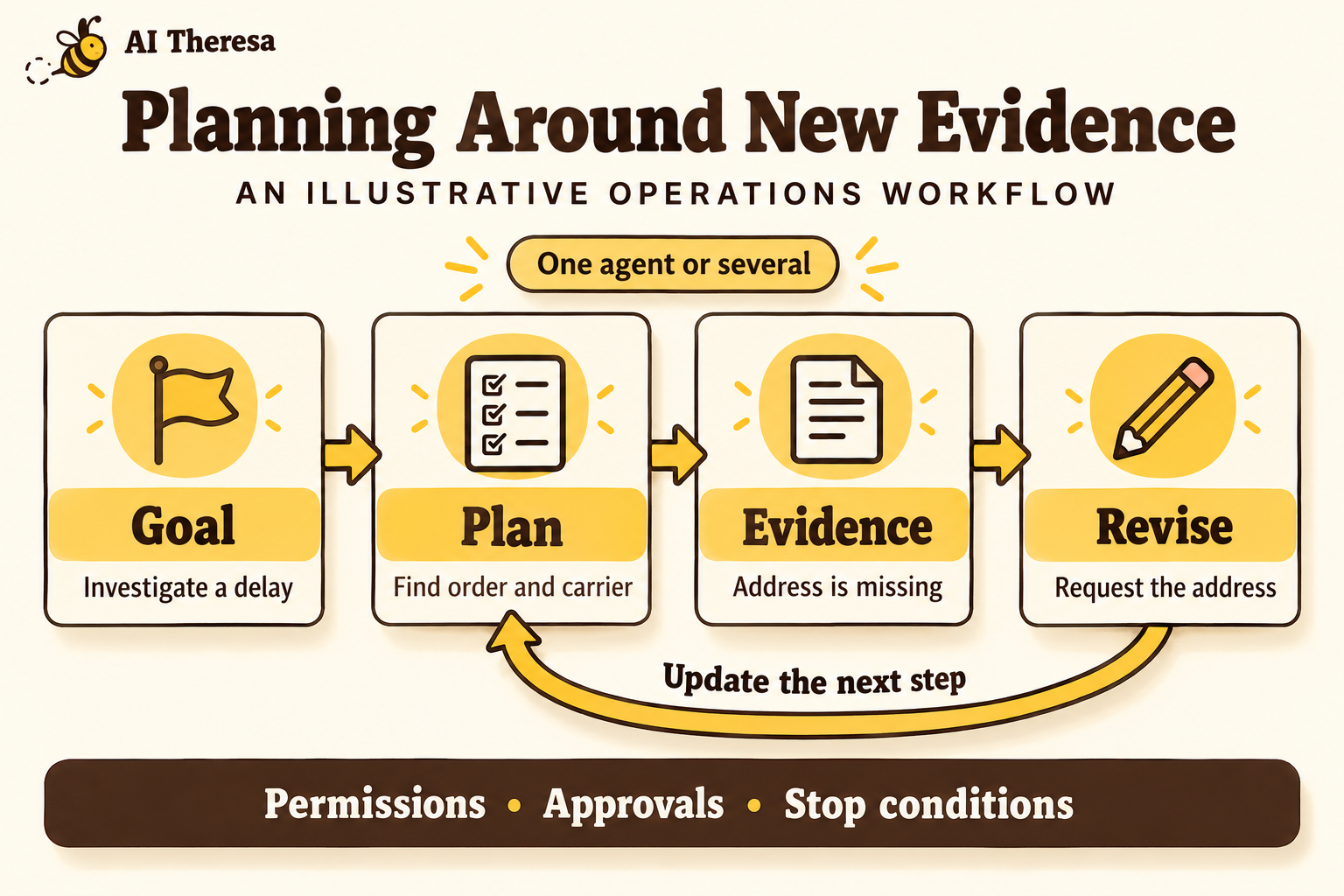
Our agentic workflow automation guide explains how these decisions fit into a larger business process.
Get Started with Theresa for FREEAI Agents vs Agentic AI: Core Differences
The terms answer different questions about the same software. “AI agent” identifies what performs the task. “Agentic AI” describes how much of the process the AI can work out as it goes.
| Question | AI agent | Agentic AI |
|---|---|---|
| What does the term refer to? | The software assigned to do a job | Its ability to choose steps and adjust its approach |
| In the purchasing example? | The assistant connected to the catalog and suppliers | How it changes the search when an option cannot meet the deadline |
| Does it require multiple agents? | No; one agent can use several tools | No, under the meaning used here |
An agentic system can complete work when it has the necessary connections and permissions.
Neither label tells you how accurate or capable a product is. An assistant may have excellent reasoning but no access to current stock. Another may have the right connections but repeatedly choose unhelpful searches. Both need testing on the work you intend to give them.
When a vendor uses these terms differently, ask what the software actually decides. Does it always follow the same sequence, choose steps within one assignment, or distribute work among several agents? Those differences are more useful for a purchase decision than the label alone.
Get Started with Theresa for FREEAI Agent vs Agentic AI: Practical Examples
Theresa: finding YouTube collaboration candidates
Theresa built a YouTube data warehouse and agent for a company managing multiple channels. The system brings channel data together to help the company track its managed channels, trending videos and channels, and potential collaboration candidates.
When asked to find potential collaborators, the agent chooses which channels to investigate, compares their performance, and produces a shortlist. The team can use that shortlist to decide which candidates to pursue, without carrying out every lookup and comparison themselves.
The AI agent is the application doing this research. Its agentic behavior is choosing which channels to investigate and using the information it gathers to assemble a shortlist.
Coding: a failed test changes the next step
GitHub documents how Copilot in the cloud can inspect repositories, edit files, and run tests. A repository is where a software project's code is stored.
Suppose the agent repairs a bug, but a test shows that the change breaks another feature. It can investigate the failure and revise the repair. The developer then reviews the changes and test results before release. Passing those tests supports the repair without proving that every possible use will work.
Physical operations: delivering goods when the route changes
At manufacturer Diva International, five OMRON autonomous mobile robots transport packaged wet wipes from production lines to stations where they are stacked onto pallets. OMRON's case study describes how the robots use a map and sensors to navigate, detect obstacles, and recalculate their routes.
Fleet-management software assigns transport jobs using factors such as battery level and distance from the pickup point. Each robot then moves the goods to its destination, adjusting its path around obstacles, including people. The result is a physical delivery between work areas.
The robot's control system performs the task; selecting and revising its route illustrates the adaptive behavior discussed here. This is robotics-based autonomy. The case study does not identify it as an LLM-powered system, so it should not be read as evidence that a language model controls the robots.
Get Started with Theresa for FREEWhere AI Agents Work Best
A focused agent suits work with a clear outcome, even when the steps vary. That might mean resolving an account query, completing a permitted record update, or researching potential business partners.
The assignment should be specific enough for an employee to check whether it is finished. “Resolve this invoice discrepancy” gives the agent a clearer job than “improve our finances.” It also needs access to the relevant records and tools. A well-defined task can still stall if the agent cannot find the information or make the authorized change.
Get Started with Theresa for FREEWhere Agentic AI Delivers More Value
The extra value comes from the decisions an agent can take over during a task. This builds on the uses above: it is not a separate category of software that businesses must buy next.
In collaboration research, the agent takes over channel selection and comparison, leaving employees to assess the shortlist and decide whom to approach.
Flexibility is less useful when a process already has a reliable sequence. Sending a standard reminder on a known date may need only a scheduled rule. Adding an agent would introduce more decisions without necessarily improving the result.
The benefit also needs to survive the time spent checking and correcting work. For illustration, suppose manual investigation takes 20 minutes per case. Agent-assisted work takes eight minutes to review and four minutes to correct. That saves eight staff minutes before maintenance is included. If correction grows to 15 minutes, the same design takes more staff time than the original process.
Use a mix of routine, difficult, and unresolved cases when making that comparison. Easy examples alone can hide the work employees still have to finish.
Get Started with Theresa for FREECan AI Agents Operate Within Agentic AI Systems?
Yes. A larger application can assign different parts of a goal to separate agents. For a supplier review, one could compare product specifications while another examines supplier documents. A coordinating agent combines their findings.
Those checks can happen at the same time when each agent has the information it needs. Some steps must wait: checking delivery for a particular product requires knowing which item and destination to use.
The findings need enough detail for the next agent to use them. A conclusion that a supplier “looks suitable” is less helpful than a list of requirements met, supporting records, and unanswered questions.
Shared actions need coordination too. Two agents should not independently place the same order. Giving one part of the application responsibility for submission prevents the workers from each treating their recommendation as permission to buy.
Several agents are worth considering when dividing the work helps. One agent with access to several tools may be enough for a smaller assignment.
Get Started with Theresa for FREEChallenges of Building Autonomous AI Systems
Long tasks can lose track of earlier decisions
As documents and tool results accumulate, an agent can overlook an earlier requirement or repeat completed work. Tasks that span several sessions also need a reliable way to carry progress forward. Anthropic's work on long-running agents documents failures such as unfinished work being mistaken for a completed assignment.
The application needs a saved record of decisions, completed steps, and unresolved questions for the agent to consult. Checking smaller stages of work helps it progress without relying on one ever-growing conversation.
Mistakes can carry into later steps
An agent that selects the wrong customer or product can produce a convincing answer about the wrong case. Later checks may all succeed while supporting that initial mistake. The application needs to keep the correct record identifiers attached to the work and ask for missing information when it cannot establish a match.
Retrieved content can redirect a decision
A document or supplier page could contain instructions telling the agent to ignore company rules or send information elsewhere. Content found during a task should not gain authority over the application. OWASP's guidance on excessive agency explains the risks of giving AI systems excessive tools or permissions. Limiting access reduces the damage a mistaken action can cause.
An interrupted action can be difficult to recover
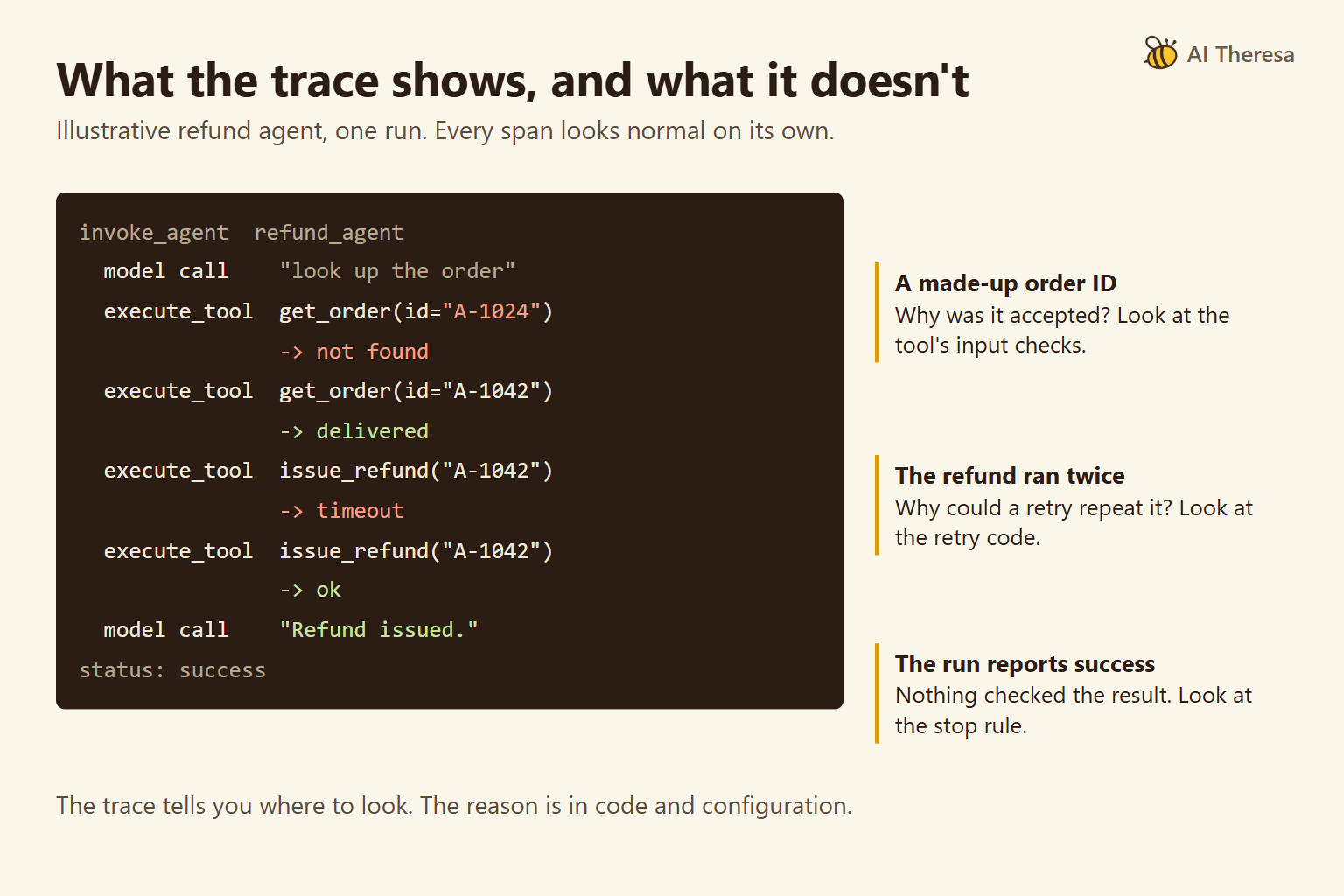
A supplier may accept an order just before the connection fails. Trying again immediately could create a duplicate. The application needs to check whether the first order exists before deciding whether to retry.
Agents also need limits on time, spending, or attempts. When they cannot finish within those limits, they should return completed work and explain what remains unresolved. Our enterprise AI agent deployment guide covers these operational requirements.
Get Started with Theresa for FREEChoosing the Right Approach for Your Business
Start with one job and the result you want. A fixed workflow can handle a known sequence, even if AI helps interpret the initial request. An agent is more useful when someone must decide what to do next after reading new information.
Give competing designs access to equivalent information. Comparing an agent with current records against a workflow with an outdated database would confuse better data with better decision-making.
Try requests that cannot be completed as well as straightforward ones. A useful assistant explains why a requirement cannot be met, instead of dropping it to produce an answer. Check the resulting records or completed work alongside the explanation it gives the user.
Decide which actions the business is comfortable delegating. Routine task creation might happen automatically, while a purchase above a set amount needs approval. Employees should know what remains theirs to decide and how to correct a mistake.
Finally, include software usage, integration maintenance, and staff review in the cost comparison. A system that completes more work but creates substantial checking and repair effort may not save the business money.
Get Started with Theresa for FREEFinal Words
An AI agent is the software carrying out a task; agentic AI describes how it chooses steps and adjusts along the way. One agent can do this on its own, and several can cooperate when there is useful work to divide.
For a business, a worthwhile deployment completes work reliably enough to reduce the team's workload. Choose the amount of independence that helps the job, with clear limits on what the software can change.