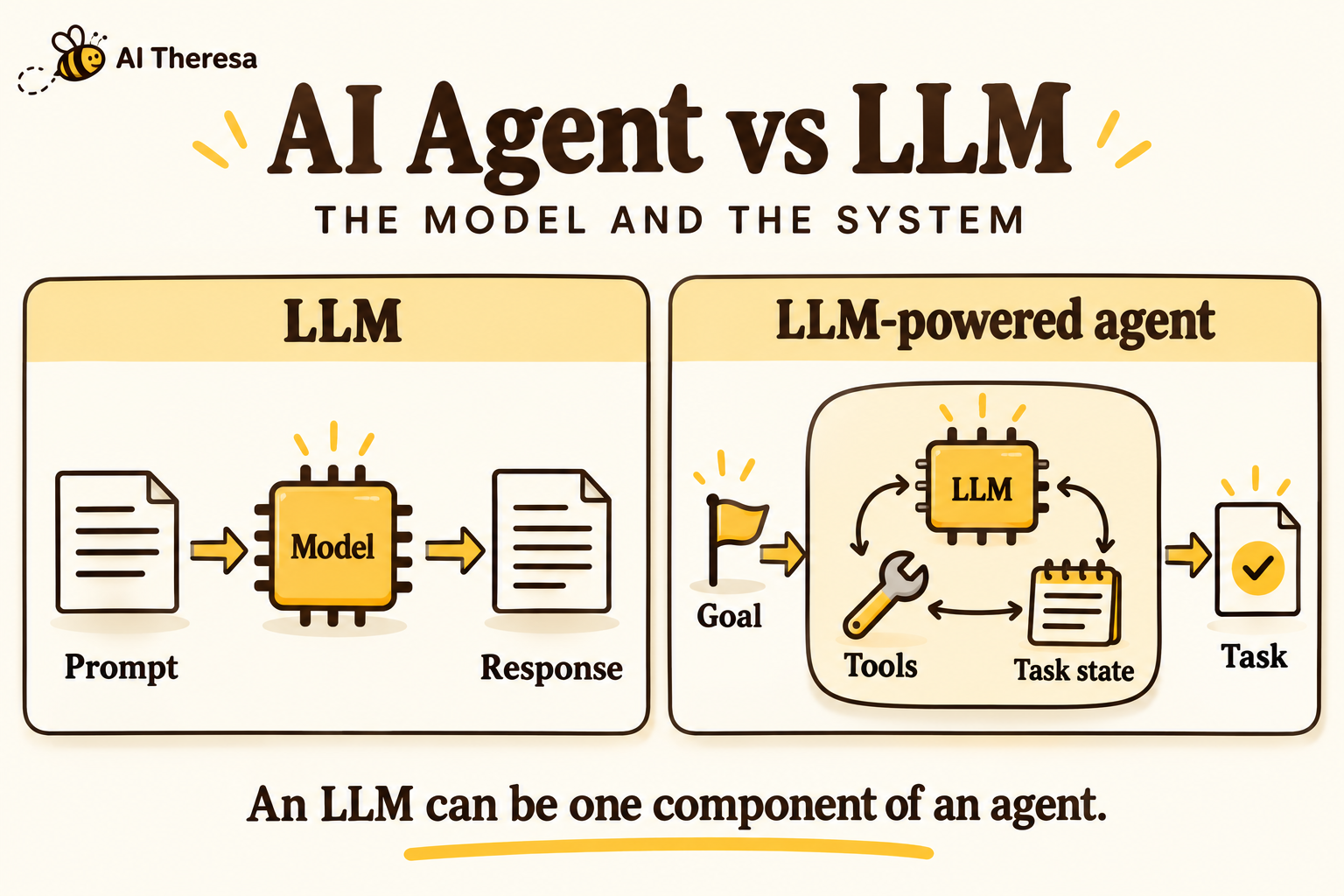
An LLM, or large language model, interprets language and generates responses. An AI agent chooses and carries out actions toward a goal, such as finding a suitable appointment and booking it. Many agents use an LLM to understand requests and decide what to do next, so a business may use both in the same application.
The choice depends on the job. Drafting an email may need only an LLM-based application. Following a known sequence can be ordinary automation. An agent is useful when the next step depends on what it finds along the way.
What Is a Large Language Model (LLM)?
A large language model is AI software trained on large amounts of text and other data. It learns patterns that help it interpret requests and generate responses. IBM's introduction to LLMs explains this training process.
A sales manager can supply meeting notes and ask for a follow-up email. The model draws on its training and those notes to draft the message. A person or connected software must then send it and update the customer record.
The information supplied with a request is called context. It can include instructions, documents, and current business records. This helps the model answer without retraining. Supplying one document does not give it access to other company files.
The model is one part of the product you use. A chat application may also provide file search or web browsing. Searching documents alone does not make it an agent; the distinction is whether the system chooses how to continue toward a goal.
Get Started with Theresa for FREEWhat Is an AI Agent?
An AI agent decides what to do next using the information available. In an LLM-powered agent, the model interprets the request and helps choose a step. The surrounding software carries it out and returns the result for the next decision.
Tools let it look up a customer record, check a booking, or update a business system. An unavailable appointment can change its next step. Saved task information helps it keep track of what has already happened.
A provider can supply these capabilities as a service, or a development team can build them into an application.
Definitions vary. Here, we follow Anthropic's distinction between workflows and agents: workflows follow predefined steps, while agents let the model direct the work. Agents without LLMs are covered later.
An agent can complete a change, such as updating a reservation. Its permissions determine how far it can go: a company might allow it to gather options but require customer confirmation before changing a booking.
Get Started with Theresa for FREEAI Agent vs LLM: Key Differences
Output versus continued execution
A request to a model produces a response, such as text, code, or a proposed action. An agent can carry out that action through its tools, then use the result to decide what to do next.
For example, explaining how to change a reservation is different from completing the change. The latter needs a connection to the booking system and confirmation that it succeeded.
Tool requests versus tool results
A tool request asks software to do something; the result tells the agent what happened. A booking change can fail because the slot is full or access is denied.
The application or model provider can run the tool, as Anthropic's documentation explains. Either way, the agent needs the result before it can confirm success.
Model parameters versus task state
Parameters are numerical values that capture what the model learned during training. Task state is the saved information about a particular job, including completed steps and unfinished work.
An agent can save a booking reference and the customer's chosen date. If the conversation resumes tomorrow, the application supplies those records to the model. It can continue the task without retraining the model to remember the booking.
Model quality versus system quality
A good model can receive the wrong customer record. A reliable tool can return the right record and still have the model misread it. These problems need different fixes.
For a model, check whether the answer matches the supplied information. For an agent, also check the resulting records. A polite confirmation is still a failed result if it changed the wrong customer's reservation.
Get Started with Theresa for FREEAI Agent vs LLM: Side-by-Side Comparison
The agent column describes the complete system, including its model.
| Question | LLM | Complete LLM-powered agent |
|---|---|---|
| What does it produce? | A response: text, code, extracted details, or a proposed action | An answer or completed task, including allowed system updates |
| Where does its information come from? | Knowledge learned during training, plus information supplied with the request | The same, plus tool results and saved task records |
| How does it take action? | Proposes an action for other software to execute | Runs allowed actions through tools and checks results |
| What happens after a response? | A person or application decides whether to ask again | The system chooses whether to continue, pause, or finish |
| How is progress remembered? | Earlier work must be supplied with the request | The application saves and retrieves task records |
| What needs maintaining? | The model connection, supplied information, and answer checks | Those parts plus tools, task records, and action permissions |
| What contributes to cost? | Model use, hosting where needed, and review | Those costs plus tool use, system connections, and retries |
One model can serve several agents, and an agent can use different models for different steps.
A fixed workflow can also send messages or update records. An agent lets the model choose some next steps based on what it finds.
Get Started with Theresa for FREEHow AI Agents Use LLMs for Reasoning and Decision-Making
Turn the request into a useful investigation
Consider a hypothetical coding task: a program importing spreadsheet data sometimes drops the last row. The agent receives the bug report and access to the project. It finds the relevant code and runs a check that confirms the problem.
The LLM helps decide where to look and what explanation to test. The tools read the files and run the checks.
Use tool results to revise the approach
Suppose the first repair restores the missing row but causes another file to load incorrectly. An automated test reveals the new problem. The agent uses that result to revise its repair and runs the checks again.
The developer no longer has to coordinate every check and follow-up. A predefined sequence could run the same tests; the agent's contribution is choosing how to respond to an unexpected failure.
Decide when to continue or finish
The LLM uses each result to choose what comes next:
- If a check fails, revise the fix and test again.
- If the checks pass, summarize the changes for the developer.
- If a check cannot run, explain what remains unverified and ask for help when needed.
The application can set a limit on repeated attempts so the agent does not keep trying indefinitely.
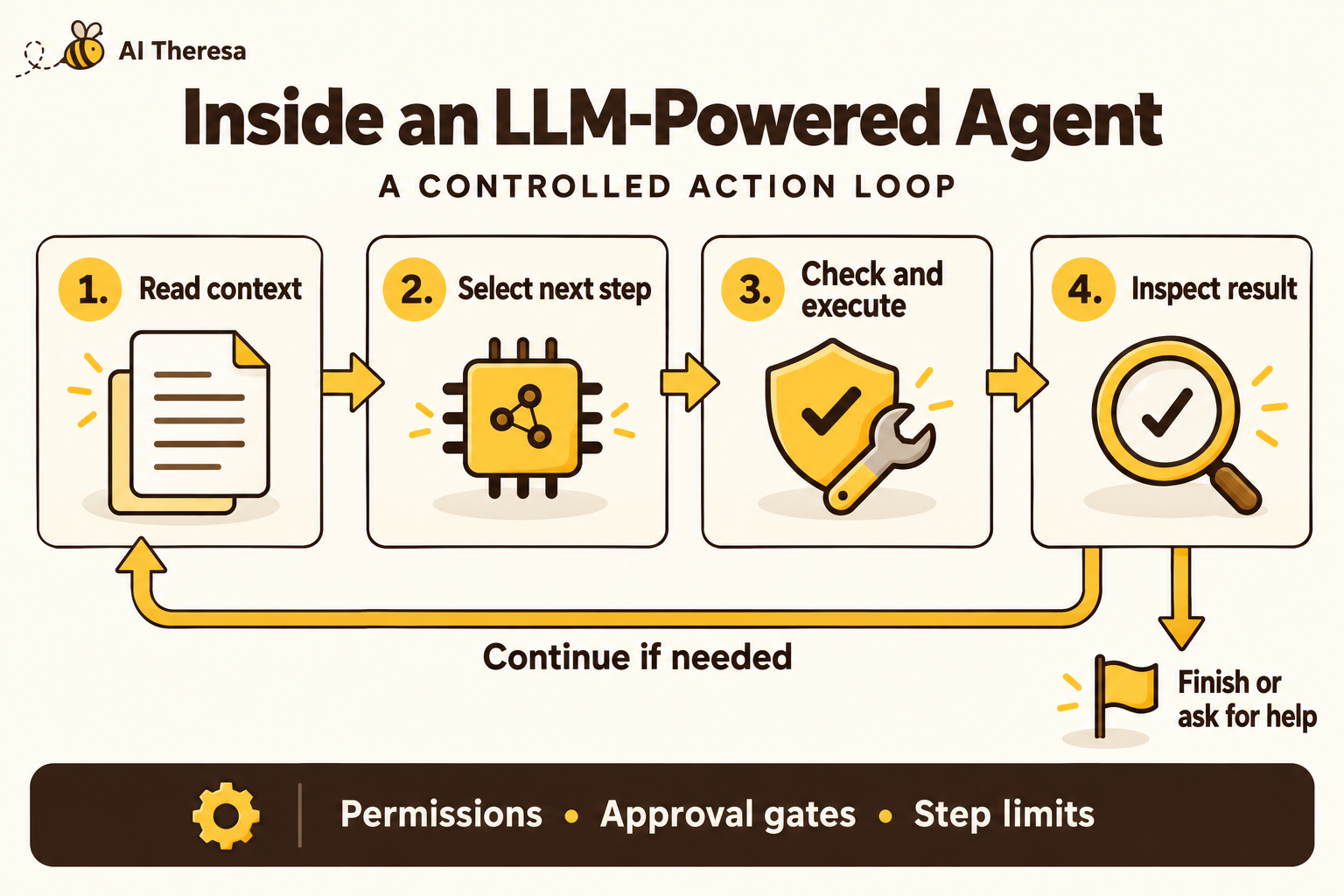
Our agentic workflow automation guide explains how this feedback loop fits into a wider process.
Get Started with Theresa for FREEAI Agent vs LLM: Real-World Examples
GitHub Copilot: from code advice to a checked change
GitHub documents how Copilot in the cloud can examine code projects, edit files, and run automated checks. It can use the results to assess a proposed change.
The spreadsheet-import scenario above is illustrative, not a reported Copilot result. It shows the change in the developer's work: reviewing edited files and test results instead of copying a suggested fix and coordinating each check.
Theresa: turning meeting commitments into tracked work
At Theresa, an internal workflow turns Zoom meeting summaries into tracked tasks called GitHub issues. The agent identifies commitments, selects the relevant repository (the GitHub project where the work belongs), and checks earlier tasks to avoid duplicates.
The workflow routes tasks to designated people through Slack and reports when they are closed. It also reports when code changes are accepted into the project and when they are released to users.
An LLM can extract action items from a summary. Here, the agent also decides where they belong and checks existing work before creating tasks. Connections to GitHub and Slack carry out those decisions. Status notifications can follow fixed rules; they do not all require model reasoning.
Service operations: language output connected to actions
Salesforce's Agentforce service examples include checking reservation slots and finalizing a booking after the customer confirms the date. Businesses must configure these capabilities for their booking process.
For "Move my reservation to Friday afternoon," an LLM given the booking policy can explain the process. A connected agent could find the reservation, check suitable slots, ask the customer to choose, and submit the agreed change.
If the requested time is unavailable, it can offer alternatives. The customer gets a confirmed update or an explanation of why the change could not proceed.
The business supplies the connections and rules. The model selects follow-ups; the booking system checks and records the change.
Get Started with Theresa for FREECan AI Agents Work Without LLMs?
Yes. An agent can choose actions using rules, search, or behavior learned through trial and feedback, without generating language.
Google DeepMind's AlphaGo combined neural networks with search to choose moves in Go. It evaluated board positions and possible moves without an LLM.
A game has defined moves and rules. A business request may involve unfamiliar wording, where an LLM can help interpret what someone needs.
Systems can combine approaches: an LLM might interpret a maintenance report while conventional software plans a schedule around available staff. A reliable calculation can stay in ordinary software.
Get Started with Theresa for FREEWhen Should You Use an LLM vs an AI Agent?
Use a direct model interaction for a bounded output
A model-based application may be enough for a summary, draft, or details taken from a document. You supply the material and review the response. Software can check for required fields; people check meaning and accuracy where needed.
Use a workflow for a known sequence
A document workflow might always read a submission, check that required details are present, and send incomplete forms to a person. An LLM can help read the document while ordinary software determines the steps, including what happens when a check fails.
Use this approach when the documents change but the processing steps stay the same. Tools, branches, and multiple model calls do not by themselves require an agent.
Use an agent for an adaptive investigation
Consider an agent when findings change the next step. A meeting commitment may already be tracked; an unclear service request may need follow-up questions. The agent can continue through to a finished report or an authorized record update.
The added cost includes repeated model requests, running the connected tools, and reviewing the work. An existing workflow can give one uncertain task to an agent while keeping the rest of the process fixed.
Get Started with Theresa for FREEHow to Choose the Right AI Approach
Your firm does not need to develop its own language model. You may be able to use features in existing software, buy a service, or have a team connect an agent to your systems. Check what is included and what needs setting up.
Start with one recurring task that takes staff time. Write down the result you need, the information involved, and the steps people take today. Drafting a customer reply may need only a model-based application. Resolving the request may also require checking records and making an agreed change.
Try suitable options on the same sample tasks. Compare them with your current process, including any work people must finish afterward.
| Decision | What to establish |
|---|---|
| What counts as finished? | A usable answer, completed report, or confirmed system update |
| Are the steps predictable? | Whether fixed rules can handle the work and common exceptions |
| What must it connect to? | Required records, available connections, and access permissions |
| What remains for people? | Approvals, corrections, missing information, and specialist decisions |
| Does it improve the result? | Correctly completed tasks, turnaround time, and cost including staff effort |
For reservation changes, check that the right booking has the agreed date. Test unavailable slots, unclear requests, and failed connections too. Count unresolved cases and repeated attempts alongside successes.
An agent may make more requests to the model while saving staff time overall. It may also cost more to maintain than the work it replaces. Measure both before expanding. Our enterprise deployment guide covers the connections and setup needed to run it.
Get Started with Theresa for FREEFinal words
An LLM can provide the language understanding and output a task needs. An AI agent adds a way to choose actions, use connected tools, and continue working from their results.
Choose the approach that completes the intended job with acceptable quality and total effort. Keep predictable steps in a fixed workflow, and use agent decisions where the work benefits from adapting to new findings.