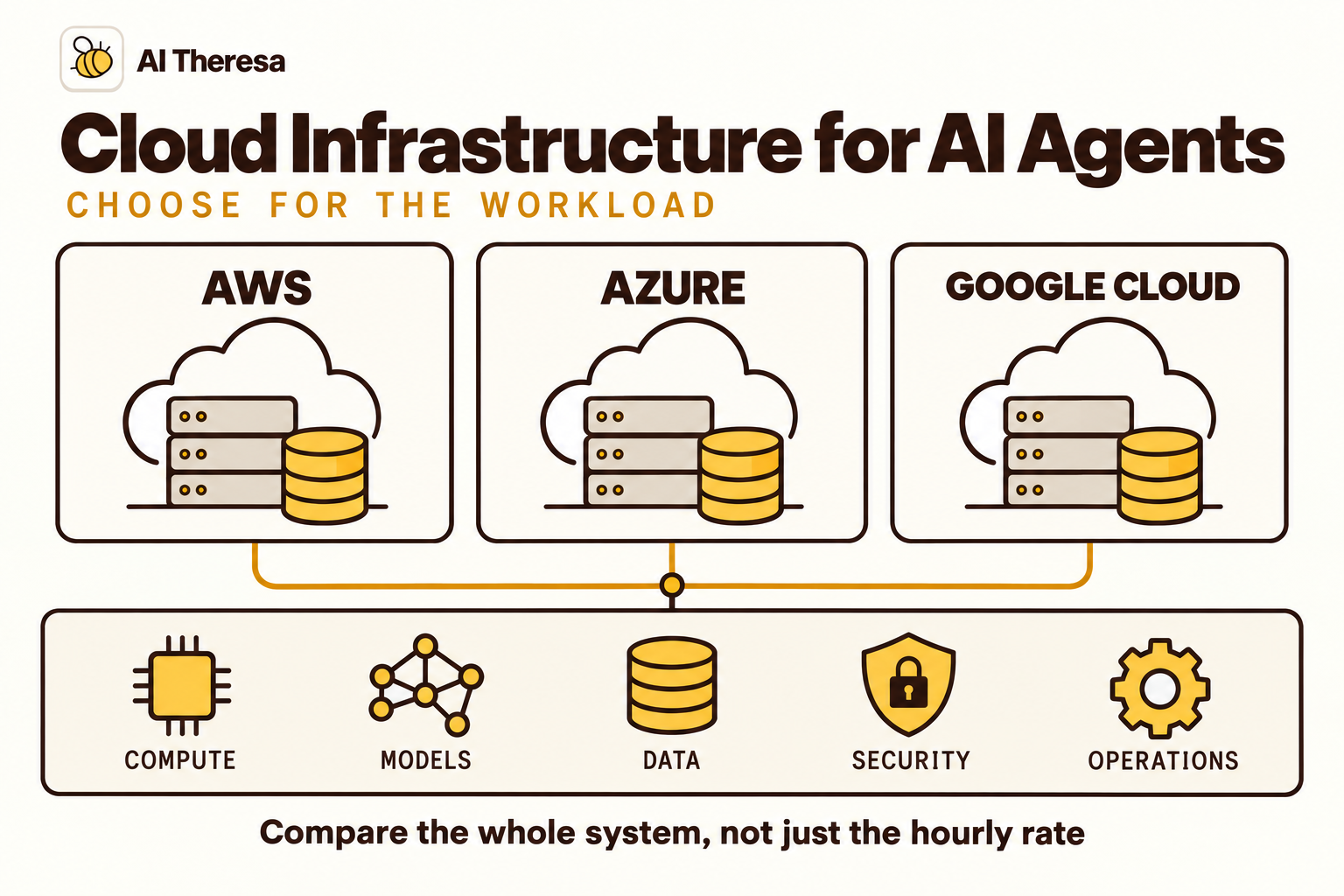
The best cloud infrastructure for an AI agent depends on where its data lives, what its tools execute, and which services the team can operate. Start with the cloud already supporting those systems. Move to another provider when a specific runtime, network, model, or cost requirement justifies the integration work.
AWS AgentCore, Microsoft Foundry Agent Service, and Google's Agent Runtime provide managed agent hosting. Specialist platforms can add a place to run generated code or a way to resume interrupted work. You can adopt those capabilities without moving the whole application.
An agent calling a model API has different requirements from a coding agent running builds or a service hosting model weights. This guide separates those workloads, compares platform capabilities, and explains the billing units. The platform recommendations below are based on documentation, not a cross-cloud performance test.
Which cloud should you shortlist?
The shortlist below separates business integrations, code execution, and work that pauses for approval.
| Your situation | Start with | What would justify a different choice? |
|---|---|---|
| Your agent works with existing AWS applications | AgentCore or your current AWS application hosting | A required environment or operating capability that the existing setup cannot provide economically |
| Employees use Microsoft identity and need an agent in Teams | Microsoft Foundry Agent Service | Custom code, networking, or tool requirements that do not fit the selected service |
| Company data and applications already run on Google Cloud | Google Agent Runtime or existing Google Cloud hosting | A demonstrated capability or cost benefit large enough to justify new connections and support work |
| You already operate reliable application servers | Your current container or virtual-machine platform | Managed hosting removes enough maintenance work to cover its cost and migration effort |
| The agent executes generated code or controls a browser | A sandbox alongside the application | Required packages, persistence, isolation, or hardware are missing from your current execution tools |
A new project can start with ordinary application hosting and a model API. Add a managed runtime when its execution and operating features solve a concrete problem. Hosting model weights is a separate decision; an agent using a hosted model does not need its own inference GPUs.
Get Started with Theresa for FREEWhat is AI agent cloud infrastructure?
AI agent cloud infrastructure is the computing, storage, networking, and monitoring used to run an agent. It keeps the application reachable, gives its tools somewhere to execute, and stores the information needed to continue its work.
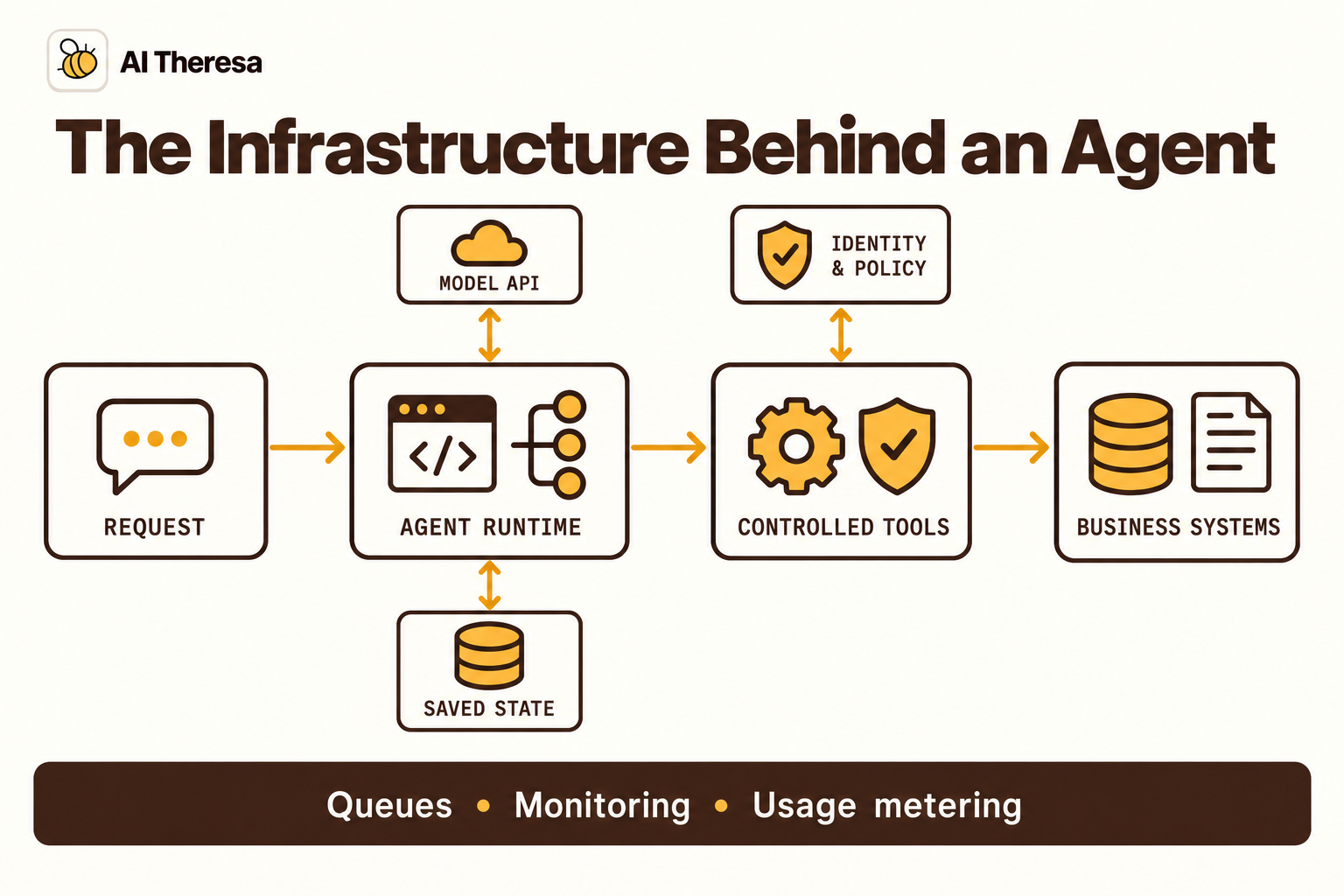
The diagram separates the purchases. Application hosting runs the agent; model access supplies its responses; saved progress lets work continue after a pause. Controlled tools may call existing business APIs or use a sandbox to execute generated code. These pieces can share one provider or use separate services. A sandbox's files and a workflow's record of completed actions serve different purposes.
Agent runtime and model runtime
The agent runtime runs the code that coordinates model requests and tool calls. When it calls a hosted model API, ordinary CPU and memory may be sufficient for that application work. The provider operates the model's inference hardware separately.
The model runtime loads the model files and generates responses, a process called inference. Hosting it yourself adds memory, accelerator, startup, and serving-capacity requirements. A deployment can therefore use one provider for the agent and another for inference, subject to its data and network requirements.
Model charges cover the input and output processed by the AI. Hosting charges cover the computing resources used to run the agent's application. If model calls make up most of the bill, cheaper hosting may barely reduce the total cost.
Runtime sessions and durable tasks
A runtime session is a period of work in a running environment. A task can last longer, for example while waiting overnight for approval. Durable execution saves enough progress for a worker to continue after that pause or a failure. It can be part of the hosting platform or supplied by a separate workflow service.
Saving progress does not automatically make repeating an external action safe. A payment or ticket update still needs a way to recognize that it already happened.
Infrastructure and business authority
Cloud identity establishes which service is making a request. The application must also enforce which customer record or business operation that request is allowed to affect. Hosting the agent inside a private network does not replace those rules.
Get Started with Theresa for FREEHow does AI agent infrastructure work?
For an agent investigating an account issue, the infrastructure supports the following steps.
Requests enter an authenticated application
An employee submits a request through a chat interface or business application. The entry point identifies the user, assigns a task ID, and starts a run. Event-triggered tasks use a service identity. Longer work can enter a queue and continue in a background worker after the employee closes the page.
The runtime coordinates models and tools
The runtime sends context to the model and checks proposed tool actions before executing them. It might query account history, search documents, or prepare a ticket update. Results return to the agent for its next decision. Each additional model call or retry affects completion time and cost.
State and records survive interruptions
Save progress outside temporary workers. If an update loses its confirmation, check whether the receiving system saved it before trying again. Our enterprise deployment guide explains recovery and duplicate prevention.
Monitoring follows the complete task
A trace connects a request to its model calls, tool results, and outcome. It shows whether a slow task waited on inference, a database, or an approver. Check the resulting business record too: a successful HTTP response cannot establish that the correct account received the intended update.
Get Started with Theresa for FREEHow to choose the right cloud platform
Choose one representative workflow before comparing features. An account investigation that must read a private database and wait for approval will expose requirements that a standalone chat demo never exercises.
Start with data location and existing systems
List the applications and records the agent needs, including which system holds the current value for each fact. Keeping execution near those systems can simplify access and avoid unnecessary transfers.
For one client deployment, Theresa chose Google Cloud because all of the client's applications already ran there.
Match hosting to the workload
These three illustrative deployments lead to different infrastructure choices:
| Work to complete | A practical starting setup | The requirement that changes the choice |
|---|---|---|
| An internal data agent answers questions using approved database queries | Existing application hosting near the database, a hosted model, and controlled query tools | A private connection or model quota may matter more than a new agent runtime; predefined tools may need no code sandbox |
| A coding agent changes a repository and runs its tests | An agent application plus a sandbox with build tools and working files | Dependencies, memory, and keeping files between sessions determine whether the environment can finish the job |
| An agent prepares a purchase request, waits for approval, then submits it | A worker with saved task state and an approval event that resumes it | The system must remember the approved request and check whether submission already succeeded before retrying |
A browser task may need signed-in sessions and downloaded files. A large software build may need far more memory than the application coordinating it. Size the tool environment separately, and choose whether to preserve it or recreate it from saved files.
Test scalability across the entire path
Model quotas, databases, and business APIs can limit throughput before application compute does. For example, 60 tasks per minute requiring five model calls each produce 300 calls per minute before retries. If the model quota is lower, more workers create more throttling; queue work, reduce calls, or obtain more quota.
Concurrency is the number of runs handled at once. Each may hold documents, tool responses, and database connections, so measure memory during busy periods. For interactive work, record time to the first useful response and time to completion separately. A background job may tolerate queuing while still needing to finish before a business deadline.
Examine security at the service level
Check who can invoke the agent, which identity calls each tool, and which records it can access. Keep credentials out of model context and grant tools only the access they need.
A private entry point does not make outgoing model requests or log storage private. Check each selected service's region, network path, and encryption support. For generated code, examine the sandbox's isolation boundary and restrict its network access; isolating the machine does not stop it misusing credentials you deliberately provide.
Decide what must stay available
Set the acceptable interruption for the business task. An internal assistant may fall back to an existing manual process, while an overnight operation may need automatic recovery before its deadline.
A second location helps only if its dependencies remain available. Two agent copies can both fail when they rely on one unavailable database. Test replacement workers and dependency failures, including whether recovery could submit the same action twice. Add multi-region operation when the required recovery time justifies its cost and complexity.
Compare the complete bill
Separate model usage from application hosting, then add data access and operating costs. A cheap CPU rate says little about a task that makes many expensive model calls.
Here is a calculated example using Google's published standard USD rates. Assume 10,000 attempted tasks per month, five Gemini 2.5 Flash calls per task, and 2,000 uncached input tokens plus 400 billable output tokens per call. Output includes any reasoning tokens. Separately assume 100 billable runtime vCPU-hours and 200 GiB-hours of RAM. These are planning inputs, not measured performance.
| Component | Usage and published rate | Calculated charge |
|---|---|---|
| Gemini 2.5 Flash input | 100 million text input tokens at $0.30 per million | $30.00 |
| Gemini 2.5 Flash output | 20 million output tokens at $2.50 per million | $50.00 |
| Google Agent Runtime CPU | 100 vCPU-hours at $0.085 | $8.50 |
| Google Agent Runtime RAM | 200 GiB-hours at $0.009 | $1.80 |
| Model and runtime subtotal | Standard usage rates before discounts, credits, or tax | $90.30 |
This subtotal excludes storage, database queries, network transfers, logs, paid tools, and engineering or review time. Estimate these costs from the configuration you plan to run. The example uses standard model requests, without batch or caching discounts.
At 8,000 correct completions, the subtotal is about 1.13 cents per correct task. The complete figure must include the omitted costs and any retries beyond the assumed calls. Failed tasks still cost money, even when they produce nothing useful.
Check operational control and portability
Have the operating team deploy a version, inspect a failed run, export task records, and disable a tool during the pilot. Record the staff effort alongside service charges.
Moving an agent means moving its saved progress, identities, and business connections as well as code. Keep business rules and tool interfaces documented outside a provider's console so the team can estimate that work.
Get Started with Theresa for FREEBest cloud platforms for AI agents
These are reasons to shortlist each platform, not exclusive capabilities or performance rankings.
| Platform | Reason to consider it | Trade-off to examine |
|---|---|---|
| AWS AgentCore Runtime | A choice between isolated, on-demand sessions and managed machines for longer work or GPU tools | Choose the compute type around the job. Session duration, resource needs, and billing differ between the two |
| Microsoft Foundry Agent Service | A path from configured prompt agents to hosted custom code, with Microsoft identity and publishing to Teams | Decide how much behavior to configure versus code. Private incoming access and outgoing tool connections need separate setup |
| Google Agent Runtime | Managed agent execution alongside Google's session, memory, evaluation, and monitoring services | Choose which services the application actually needs. Resource allocation affects cost, and regional and security support varies by service |
All three support agent hosting, private business connections, and retained context. Compare what they preserve: conversation history, working files, and completed business actions are different records.
Private access requires the applicable AWS VPC, Azure networking, or Google Private Service Connect configuration. Record permissions remain the application's responsibility.
Specialist platforms can fill a gap in the selected cloud service. Their roles overlap: workflow platforms may host agent code, while compute platforms may also offer sandboxes. Compare the capability you need and the work left to your team.
| Option | Where it fits | What remains your responsibility |
|---|---|---|
| Control Plane | Application hosting across cloud infrastructure through a common operating interface; sandboxes are also available | Business integrations, task recovery design, and the configuration and cost of the locations you select |
| E2B | SDK-controlled sandboxes for code execution and tools, with filesystem and memory preserved through pause/resume | The surrounding application, business access, and the record of what the agent completed |
| Modal | Sandboxes alongside serverless compute, including GPU-backed execution when tools need it | Setup and recovery beyond the 24-hour sandbox limit; GPU sandboxes use gVisor, which filters system calls through a separate software kernel |
| LangSmith Deployment | Hosted agent execution with durable progress, streaming, and scaling; also offers customer-hosted deployment choices | Tool integrations and matching hosting and license requirements to your environment; separate code-execution needs |
| Trigger.dev | Running TypeScript background tasks with retries, queues, and waits | Business-action duplicate prevention and services outside those tasks, such as databases or code sandboxes |
For example, an application can keep its customer data on its existing cloud and call E2B for one code-execution step. Only the information needed for that step should enter the sandbox. That adds another service and data boundary, but does not require migrating the database. Compare this arrangement with the cloud's own execution tools before adding a supplier.
AWS: flexible compute and longer-running sessions
Amazon Bedrock AgentCore Runtime runs your agent code with a choice of frameworks and model providers. Choose isolated virtual-machine sessions (microVMs), lasting up to eight hours, or AWS-managed EC2 Instances for sessions up to 14 days, GPU work, or agents sharing a machine.
With supported stop/resume cycles, a coding agent can resume a stopped session with its files, installed packages, and build outputs intact.
Your application still needs to record completed business actions and decide where to continue. Preserving a repository does not tell the agent whether it already opened a pull request. Tool permissions and connections to business systems also need configuration.
Azure: configured agents or custom code
Microsoft Foundry offers prompt agents configured through instructions and tools, or hosted agents running your code in managed containers. Hosted agents give you control over the framework and request handling.
Designated session files survive idle periods. The Responses interface also manages conversation history; custom request handling leaves that to your code. Sessions expire after 30 days without activity, so they are not permanent document storage.
Recovery after a process interruption requires explicit setup. Foundry can restart the work, while your code saves completed steps and prevents repeated actions. You also configure business-system access through the user's permissions or the agent's own identity.
Google Cloud: managed execution with session and memory services
Google Agent Runtime deploys agent applications from source or containers. You configure the compute resources and number of simultaneous requests; Google operates the hosting.
Sessions stores conversation events and state so an agent can resume an interaction. Google's Agent Development Kit manages sessions automatically when deployed; other implementations can use the API. Memory Bank separately retains information across conversations. Saving a conversation does not preserve the worker's installed software or local files.
Your team connects the required data and tools, grants access, and stores working files where they can survive worker replacement. It also defines how saved conversation state translates into the next unfinished business action.
Pricing comparison: published rates and what they exclude
These USD rates price individual components, so the rows do not represent equivalent deployments. Region, runtime version, allowances, and contract terms can change the applicable bill.
| Service | Published pricing example | Additional costs to consider |
|---|---|---|
| AWS AgentCore Runtime microVMs | V1: $0.0895 per vCPU-hour and $0.00945 per GB-hour. V2 consumption: $0.1276 per vCPU-hour and $0.0169 per GB-hour. | Model inference, storage, network traffic, and separately metered capabilities. |
| Azure Foundry Agent Service | No additional agent-service charge for Foundry-native prompts and workflows; hosted agents incur container-compute charges. Obtain the applicable regional rates in Azure's pricing tools. | Model tokens, tools, knowledge connections, and relevant licenses. |
| Google Agent Runtime | Standard rates: $0.085 per vCPU-hour and $0.009 per GiB-hour. Confirm applicable discounts and account-specific credits separately. | Model usage and separately billed data, gateway, memory, or other services. |
AWS microVM billing distinguishes resource consumption and runtime versions. Google charges for allocated runtime CPU and memory, excluding idle time between turns. A lower hourly rate may therefore produce a higher bill if more resources are allocated than the work uses. GB and GiB are different memory units, so normalize those as well.
Use the same workload to estimate each candidate's bill. The $90.30 example above prices one assumed Google configuration; it does not establish that Google is cheaper or faster than AWS or Azure. Different resource allocation and execution time can outweigh a lower published rate.
When custom hosting is the better choice
Managed agent services are not mandatory. A team with an established container platform may prefer to host its orchestration code there and call model APIs separately. This can suit a simple workflow or code that needs libraries and system tools unsupported by a managed agent service.
Custom hosting is attractive when your team already handles patching, capacity, task recovery, identity integration, and monitoring. Otherwise, budget the engineering work to establish those capabilities alongside compute charges.
Google's architecture guidance treats the agent runtime and model runtime as separate choices and discusses managed agent hosting, Cloud Run, and GKE. The same design question applies elsewhere: which services do you need the provider to operate, and which can your team already run?
Run a pilot that can settle the decision
Compare two plausible configurations with the same tasks, model, and input sizes. Record unavoidable differences, such as provider-specific search, so their effects are not mistaken for better hosting.
Record correct completions, failures, model and hosting costs, and staff effort. Measure typical completion time and p95: the time within which 95% of completed tasks finish. Count failures separately so dropping difficult work cannot make a service look faster.
If neither candidate reaches the required systems reliably, address the connection or data problem before comparing speed. Forward-deployed engineering support can help with integration work that changing hosts would leave unresolved.
Get Started with Theresa for FREEWhat to record before choosing
Keep the chosen services, region, model, resource settings, measured costs, and recovery results with the decision. Record why the other candidate was rejected so a later price or requirement change can be assessed without repeating the whole investigation.
Use the results to identify what needs changing: application hosting, tool execution, or task recovery. A problem with one component may not require replacing the others.
The best cloud infrastructure for AI agents is the setup that completes the business's work at an acceptable total cost. Include migration and ongoing support in that decision.